The U.S. space agency National Aeronautics Space Administration (NASA), European Space Agency (ESA), and Japan Aerospace Exploration Agency (JAXA) are inviting coders, entrepreneurs, scientists, designers, storytellers, makers, builders, artists, and technologists to participate in a virtual hackathon May 30-31 dedicated to putting open data to work in developing solutions to issues related to the COVID-19 pandemic.
During the global Space Apps COVID-19 Challenge, participants from around the world will create virtual teams that – during a 48-hour period – will use Earth observation data to propose solutions to COVID-19-related challenges ranging from studying the coronavirus that causes COVID-19 and its spread to the impact the disease is having on the Earth system. Registration for this challenge opens in mid-May.

“There’s a tremendous need for our collective ingenuity right now,” said Thomas Zurbuchen, associate administrator for NASA’s Science Mission Directorate. “I can’t imagine a more worthy focus than COVID-19 on which to direct the energy and enthusiasm from around the world with the Space Apps Challenge that always generates such amazing solutions.”
The unique capabilities of NASA and its partner space agencies in the areas of science and technology enable them to lend a hand during this global crisis. Since the start of the global outbreak, Earth science specialists from each agency have been exploring ways to use unique Earth observation data to aid understanding of the interplay of the Earth system – on global to local scales – with aspects of the COVID-19 outbreak, including, potentially, our ability to combat it. The hackathon will also examine the human and economic response to the virus.
ESA will contribute data from the Sentinel missions (Sentinel-1, Sentinel-2 and Sentinel-5P) in the context of the European Copernicus program, led by the European Commission, along with data from Third Party contributing Missions, with a focus on assessing the impact on climate change and greenhouse gases, as well as impacts on the economic sector. ESA also is contributing Earth observation experts for the selection of the competition winners and the artificial-intelligence-powered EuroDataCube.
“EuroDatacube will enable the best ideas to be scaled up to a global level,” said Josef Aschbacher, director of Earth Observation Programmes at ESA. “The pandemic crisis has a worldwide impact, therefore international cooperation and sharing of data and expertise with partners like NASA and JAXA seems the most suitable approach.”
JAXA is making Earth observing data available from its satellite missions, including ALOS-2, GOSAT, GOSAT-2, GCOM-C, GCOM-W, and GPM/DPR.
“JAXA welcomes the opportunity to be part of the hackathon,” said JAXA Vice President Terada Koji. “I believe the trilateral cooperation among ESA, NASA and JAXA is important to demonstrate how Earth observation can support global efforts in combating this unprecedented challenge.”
Space Apps is an international hackathon that takes place in cities around the world. Since 2012, teams have engaged with NASA’s free and open data to address real-world problems on Earth and in space. The COVID-19 Challenge will be the program’s first global virtual hackathon. Space Apps 2019 included more than 29,000 participants at 225 events in 71 countries, developing more than 2,000 hackathon solutions over the course of one weekend.
Many Filipinos participated in this annual hackathon since 2016. Recently, a dengue mapping forecasting system was developed by data scientists from CirroLytix using satellite and climate data with the goal of addressing the sustainable development goals of the United Nations. This web application, called Project AEDES won globally for the best use of data. “Earth observation data has the potential to be used in fighting epidemics and outbreaks threatening humanity nowadays, as well as to analyze its socio-economic impact,” according to software developer Michael Lance M. Domagas, who led the Philippine hackathon in collaboration with De La Salle University, PLDT, Department of Science and Technology, United Nations Development Programme, and the U.S. embassy. The very first Philippine winner used citizen science and environmental data to develop a smartphone application informing fishermen the right time to catch fish. ISDApp is currently being incubated at Animo Labs.
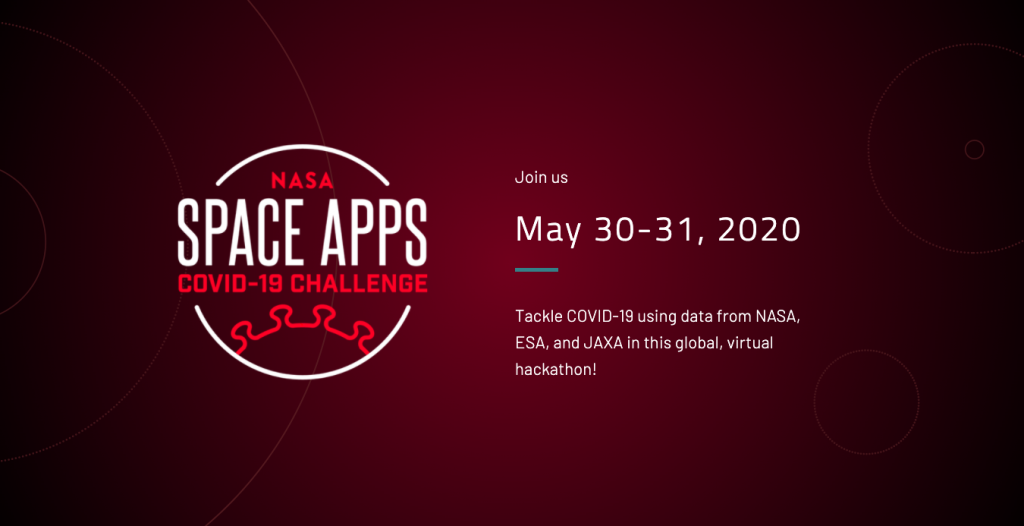
Space Apps is a NASA-led initiative organized globally in collaboration with Booz Allen Hamilton, Mindgrub and SecondMuse. The next annual Space Apps Challenge is scheduled for October 2-4.
Registration opens May 12. https://covid19.spaceappschallenge.org/
#SpaceApps #SpaceAppsPH
REFERENCE:
Michael Lance M. Domagas
Software Developer