Tag: Lamudi Philippines

  • HLURB Partners With LAMUDI, Aims To Increase Transparency

    HLURB Partners With LAMUDI, Aims To Increase Transparency

    HLURB and property website Lamudi join forces to push for transparency in real estate this 2018.

    The Housing and Land Use Regulatory Board (HLURB) and online real estate marketplace Lamudi Philippines come together for a partnership aimed at improving real estate practices in the country and encouraging transparency in the industry.

    A ceremonial signing was held in Makati on January 24, and was attended by HLURB Chief Executive Officer and Commissioner Atty. Lloyd Christopher A. Lao, HLURB Commissioner Atty. Melzar P. Galicia, Lamudi Philippines Managing Director and CEO Bhavna Suresh, and Lamudi Philippines Director for Brand and Communication Ken Lerona.

    A more visible HLURB

    Under the one-year partnership, readers of the Lamudi: Real Estate Magazine should expect thought leadership pieces from none other than Atty. Lao, with topics ranging from the rights of buyers of real estate, to the verification of brokers, projects, and developers.

    HLURB will also use the Lamudi platform to address frequently asked questions, including those about options for financing, procedures and remedies afforded to aggrieved buyers and developers, and even who to approach or look for when paying a visit to their office.

    Consistent with its aim to increase transparency in the industry, HLURB also has revamped and upgraded its website, which now comes with a user-friendly online inquiry feature. This shall be integrated in the Lamudi website which receives around 1.5M visits per month, so property seekers will find it easy and hassle-free to search for registered brokers, as well as projects that have been issued License to Sell numbers.

    All of these form part of HLURB’s efforts to keep up with the times by embracing digital, and to be more visible to the public and serve them better.

    Transparency through technology

    In the 2016 Global Real Estate Transparency Index (GRETI) by JLL, a leading real estate and investment management firm, the Philippines ranked 46th out of 109 countries and fell under the semi-transparent market. This tier, according to JLL, is where the most rapid progress in real estate transparency can be found.

    Rising expectations from citizens as well as technological advancements serve as drivers for improving real estate transparency. Innovations in the prop-tech industry, JLL says, “offer the opportunity for a quantum leap in data access to support a rising culture of ‘open data.’”

    Aside from high-quality accessible market data, ingredients of a transparent real estate market include: strong corporate governance, stringent regulatory enforcement, high ethical standards, and international best practice.

    For Atty. Lao, responsible real estate practice is the key to the sustainability of the housing sector. He also maintained that although HLURB is a regulatory body, they are very much willing to help and cooperate with those under their jurisdiction.

    Ms. Suresh, for her part, shared that Lamudi is one with HLURB in its aim to push for transparency as this shall open many doors in the future. As seen in JLL’s 2016 GRETI, higher real estate transparency is linked to new business and investment, and even plays a role in community well-being and inclusiveness.

    “As the authority in the prop-tech industry in the country, Lamudi is thrilled to be partnering with HLURB for this,” she added. “We are here to support HLURB, and look forward to more partnerships like this one.”

  • Property Oscars 2015

    Property Oscars 2015

    And the Oscar goes to…

    With awards season drawing to a close, it is not only movies and actors that deserve recognition for their work. Global real estate network Lamudi rolls out the red carpet for the Property Oscars—recognizing some of the leaders in international real estate.

    Category: Tallest Building

    Description: https://lh4.googleusercontent.com/IYHBdGddDyS7KnDmZQ29ZfijkM6Wl_gCfNbDNvsmaHY3PnYwh8cGdrfvLIDTte-8MhzfDoq3CKX93SvM8wNTFVxP_uMwooL9lFy5zl3P19Oi8ztQ220k2_aaX5cWZZ0-eu0

    And the Oscar goes to…the Burj Khalifa in Dubai, United Arab Emirates. It is 829.9 meters (2,722 ft) high and has claimed the official title of tallest building in the world since opening in January 2010. It is almost twice the height of the Empire State Building, which was the world’s tallest building for nearly 40 years.

    Burj Khalifa features 162 floors, took six years to be build and is owned by Emaar Estates. It holds several records such as tallest skyscraper, building with the most floors, world’s highest escalator installation, world’s highest restaurant and nightclub, and many more.

    Both the height of the building and its costs are enormous. The building’s price tag, at US$1.5 billion, was about 37 times the amount of the Empire State building.

    Category: Oldest Building

    Description: https://lh3.googleusercontent.com/xPOVyG4_NVWzXcpSVIWEx4a2PuDqCC8ZCMFaPMxCs57mauhpymsvc0CyQuabz0bQzRTj1YaabfbRGU3a7MZ4CR1M6UspeO2DaZE2qAR318I1AXQduE5ih9QscZO5STcP9Ug

    Considered the oldest building in the world is the nearly 7,000-year-old Barnenez, overlooking the bay of Molaix in Brittany, France. The estimated weight of the massive stone structure is 13,000 to 14,000 tons. It features 11 chambers, each entered by separate passages. No doubt the building has had many more than one owner and purpose.

    The Neolithic monument was built around 4,800 BC and classified as a tumulus (a type of grave) in 1850. But over time it was not only used to host the dead. At first the building was 32 meters long, 9 meters wide and 8 meters high. In 4,200 BC and 3,900 BC the building was extended to six further chambers added to the west, increasing its size to 72 meters long, 25 meters wide and over 13 meters high. The structure was almost destroyed after it was used as a quarry for paving stones.

    Category: Most Expensive Home

    Description: https://lh4.googleusercontent.com/21YLxmyP-huU_dsTUIuuFOzFcr1ztK9BOp3dyJs2z25cMjAAfwnaRmFTLh3MWEbzvj8ostz8pmUwaqHc5N2JBWrYYcRJcgfZZl6g6NT84-FjMKMtNPmbqKEiytrvkQfA4YA

    The 400,000-square-feet private skyscraper—situated in the south of Mumbai, India—is the residence of the world’s fifth richest man, Mukesh Ambani. He is the chairman of Reliance Industries Limited and moved in to the 27-storey skyscraper with his wife and three children.

    The first six floors are only parking lots, followed by a huge lobby with nine elevators going up Ambani’s 167.64-meter-high (550 feet) home. In the enormous home, which is known as Antilla, no two floors are the same in terms of interior and materials used. The property features several storage rooms, lounges, a large ballroom with 80 percent of its ceiling covered in crystal chandeliers, several swimming pools, a yoga studio, an ice room with man-made snow and a four-story open garden.

    The costs of the world’s largest and most expensive home were approximately US$1 billion.

    Category: Most Expensive Building

    Description: https://lh4.googleusercontent.com/qE8QQ6i5Hz4Ms2iBBX-bJMweAXLx7W3gPf3B1SMdykT7jbvK6qo18P8pRCGoj0-RqFI5-iXPHST0Cjsya13Tja49_zIS_3wGnevewn8JRcWruxa7Zs_FTXk-0QLkxb8HxcY

    Located in Mecca, Saudi Arabia, the world’s most expensive building is the Abraj Al-Bait Towers, also known as the Mecca Royal Hotel Clock Tower. It is owned by the government and had an estimate building cost of US$15 billion.

    The 601 meter-high building is part of the King Abdulaziz Endowment Project, which was introduced to modernize the city in order to cope with the massive amount of visitors who make the annual pilgrimage to Mecca.

    The Abraj Al-Bait Towers has a large prayer room capable of holding more than 10,000 people and also includes a five-star hotel to host the pilgrims, who participate in the Hajj each year.

    Category: Most Famous Home

    Description: https://lh5.googleusercontent.com/UILXDnDgWT-bedlNT_z-9gFCjUxHLNroEhyGeETztAXtZJaC3COmtPNdf81GKcGAhGXS_ABDsH0zJooEppm1Gx7LkvqjdSteIdB1hPGE00QGv1JVjBAnWKotPkgRy8pt4Wk

    The White House is the most famous home in the world and principal workplace of the most powerful man in the United States—the President.

    Built in 1792, it features six stories, of which two are in the basement, 132 rooms, 16 bedrooms and 35 bathrooms, measuring altogether 5,901.65 square meters (or 55,000 square feet). Each week the White House receives up to 30,000 visitors, 65,000 letters, 3,500 phone calls and 100,000 emails.

    In 1962 Jacqueline Kennedy, the wife of the president, directed the extensive and historic redecoration of the White House. For each room there a different theme related to the early republic and world history was selected. The best-known room is the Oval Office, which also provides the backdrop for many Hollywood blockbusters.

    REFERENCE & MEDIA CONTACT:

    Rodel Ambas

    Head of Content and PR, Lamudi Philippines

    Email: rodel.ambas@lamudi.com.ph

    Phone: +63 917 3015127

  • ASIA: The World’S Skyscraper Capital

    ASIA: The World’S Skyscraper Capital

    Global property portal looks at region’s sky-high towers.

    Home to the bulk of the tallest towers on the planet, Asia is without a doubt the world’s skyscraper capital. From Dubai to Shanghai, the region dominates the list of the world’s supertall buildings.

    Of the top 10 tallest towers around the world, just two – the recently completed One World Trade Centre in New York City and the Willis Tower in Chicago – are located outside Asia and the Middle East.

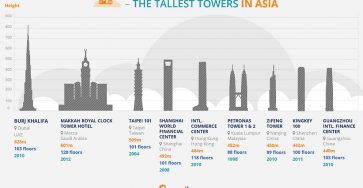
    Stacked one on top of the other, the 10 tallest towers in Asia would measure more than five km into the sky. These top 10 tallest towers are shown on a new infographic, released by global property portal Lamudi.

    With its towering commercial centres and tendency towards high-density living, China leads the world in skyscraper construction. Of the record-breaking 97 buildings measuring 200 meters high or taller that were completed around the world in 2014, 58 of these were located in China. This represents roughly 60 percent of the global total, according to figures recently released by the Council on Tall Buildings and Urban Habitat.

    The city of Dubai currently holds the title for the world’s tallest skyscraper. Reaching 829.8m high, the Burj Khalifa is the tallest artificial structure on earth. For those without a serious fear of heights, the super tower is also home to the world’s highest observation deck, located on the 148th floor.

    The Makkah Royal Clock Tower Hotel in Mecca, Saudi Arabia, is the region’s second tallest tower. Located close to the world’s largest mosque, Masjid al-Haram, the five-star hotel is designed to cater for Muslim pilgrims visiting the holy city. The structure has 76 state-of-the-art elevators offering easy access to the mosque for prayers.

    In third place is Taipei 101 in Taiwan, which stands at 508m and was once the tallest building in the world. The skyscraper’s unique design is based on the number eight, which is considered lucky in Chinese culture. The design was chosen to withstand the earthquakes and typhoons that are common in the country.

    Elsewhere in Asia, the Shanghai World Financial Center, the International Commerce Centre in Hong Kong and the Petronas Towers in Malaysia also make the top 10 list.

    Currently under construction in China is the 632m Shanghai Tower which, once completed later this year, will be the world’s second tallest building. However, at 660m, the Ping An Finance Centre in Shenzhen will overtake the Shanghai Tower in 2016.

    Set to reach 1km into the sky, the Kingdom Tower in Saudi Arabia will take the title of the world’s tallest building once it is completed in 2019.

    ABOUT LAMUDI

    Launched in 2013, Lamudi is a global property portal focusing exclusively on emerging markets. The fast-growing platform is currently available in 28 countries in Asia, the Middle East, Africa and Latin America, with more than 800,000 real estate listings across its global network. The leading real estate marketplace offers sellers, buyers, landlords and renters a secure and easy-to-use platform to find or list properties online. For more information, please visit http://www.lamudi.com.ph

    Visit  Lamudi Philippines on  Facebook, Twitter, Google+ and LinkedIn.

    REFERENCE & MEDIA CONTACT

    Rodel Ambas

    Head of Content and PR, Lamudi Philippines

    Email: rodel.ambas@lamudi.com.ph Phone: +63 917 3015127

  • Infographic: What will your house look like in 10 years?

    Infographic: What will your house look like in 10 years?

    Smart home technology gaining traction in emerging markets.

    From the moment you wake up in the morning, the house reacts to your needs. The automated lights turn on slowly to wake you up at a scheduled time. From the comfort of your bed, you switch on your coffee machine so your morning cup is fresh and hot by the time you arrive downstairs for breakfast.

    You enter the bathroom and stand in front of your intelligent mirror. The mirror’s reflective surface springs to life with all the information you need to kick-start your day, including the weather and the morning’s top news. The device also plays your favourite music so you are always guaranteed to start the day in a good mood.

    After getting ready, you go to the kitchen for breakfast where your smart refrigerator alerts you that you are nearly out of milk. With the tap of a finger on the fridge’s touch screen, you can restock your fridge and order all your groceries for the week through an online store.

    The infiltration of technology to assist with these small daily tasks may just be the beginning. The fully-connected home is designed to boost energy efficiency, protect against intruders and even monitor your family’s health. With the rapid growth in the home automation industry, so-called smart home systems have already hit the mainstream – although the high cost of such devices keeps them out of reach for many. But there are signs that this is about to change.

    This year, revenue from the smart home market is expected to exceed $US48 billion, according to recent Strategy Analytics forecasts. By 2019, the sector’s market revenue will increase to $115 billion. By the end of this decade, nearly 12 percent of global households will have at least one type of smart system installed. In fact, Tony Fadell, the CEO of Nest – the connected homes product company that was bought by Google earlier this year – has predicted that within a decade, every electrical device in your home will be connected to the internet.

    While the smart home market is quickly gaining traction in developed countries, there are now signs that the trend is spreading to the emerging markets. Consumers in the Asia Pacific region has been particularly keen to embrace the new connected technologies, as tech companies begin to acknowledge the opportunities in this sector.

    Connected home firm Icontrol Networks expanded to Asia in October, with the company partnering with a Japanese cable provider to offer a smart home system that consumers can install themselves. This month, Chinese electronics firm Xiaomi invested 1.26 billion yuan (about $200 million) in home appliance company Midea, as it looks to expand into the smart homes market.

    Lamudi’s Global Co-Founder and Managing Director, Kian Moini, said: “The smart home concept is all about making living much more comfortable, as well as more efficient, which means that the concept has universal appeal. As prices come down in the coming years and people worldwide begin to focus more on issues such as energy saving, we expect to see this trend sweep the emerging markets as well.”

    REFERENCE & MEDIA CONTACT

    Rodel Ambas
    Head of Content and PR, Lamudi Philippines
    Email: rodel.ambas@lamudi.com.ph
    Phone: +63 917 3015127

  • Lamudi rolls out iOS App to Global Network

    Fast-growing property portal’s iOS app now available in 27 countries.

    International property portal Lamudi has rolled out its iOS app for property seekers in a further 11 countries, making the popular mobile application available across the company’s global network.

    The iOS app has been progressively rolled out in countries across Asia, Africa, the Middle East and Latin America since it was launched in June. The app, Lamudi: Real Estate for Sale & Rent, is now available for iOS users in 27 countries in the emerging markets.

    With the release of version 1.5, the Lamudi iOS app has been made available in the Middle East for the first time. The app is now available with right-to-left orientation for Arabic speaking house-hunters in Jordan and Saudi Arabia. Countries which already have the app will also benefit from improved speed and security for easier browsing.

    The iOS app was this week launched in: Algeria, Cameroon, Ethiopia, Madagascar, Mauritius, Mozambique, Rwanda, Zambia, Sri Lanka, Jordan and Saudi Arabia. Lamudi’s Android app was rolled out to 28 countries in the emerging markets earlier this year.

    Lamudi’s Global Co-Founder and Managing Director, Antonius Salis, said: “Our website now hosts more than 750,000 property listings around the world. All of these have been made available to iOS users through the updated Lamudi app.

    For existing users, we have also made several improvements to the overall experience. The app is now more secure and faster to use, making searching for real estate on the go even more convenient than before.”

    The app provides the perfect platform for house-hunters to rent, buy or sell property on the go. A key feature of the Lamudi app is its customised search function, which allows users to easily switch between the 27 countries available in the app.

    The app also provides match alerts, with users receiving a notification as soon as a property that suits their needs hits the market. House-hunters can bookmark their favourite properties to access at any time and on any device.

    All listings on the app feature high-quality photo galleries, detailed property information, maps, and multiple contact details for property owners or agents. Users can also share their favourite properties with family and friends via Facebook, Twitter or email.

    ABOUT LAMUDI

    Launched in 2013, Lamudi is a global property portal focusing exclusively on emerging markets. The fast-growing platform is currently available in 28 countries in Asia, the Middle East, Africa and Latin America, with more than 600,000 real estate listings across its global network. The leading real estate marketplace offers sellers, buyers, landlords and renters a secure and easy-to-use platform to find or list properties online. For more information, please visit http://www.lamudi.com.ph

    Visit Lamudi Philippines on Facebook, Twitter, Google+ and LinkedIn.

    REFERENCE & MEDIA CONTACT
    Rodel Ambas
    Content Editor, Lamudi Philippines
    Email: rodel.ambas@lamudi.com.ph
    Phone: +63 917 3015127

  • Pros and Cons: Foreign property ownership in the Philippines

    Lamudi takes a look at the advantages and disadvantages of allowing foreign property ownership in the Philippines.

    To say that Philippine real estate is fast becoming a favorite among buyers abroad is quite an understatement. In fact, an article published in ABS-CBNnews.com reported that Asian investors—from Malaysia to Japan—are snapping up condo units in bulk. These buyers are favoring the Philippines over Hong Kong and Singapore, where the authorities have put in place cooling measures to rein in property prices.

    “There has never been this strong interest in the Philippine property market,” said Colliers International’s David Young in an interview. But despite this, the Philippines still does not allow foreign ownership of real property; foreigners, however, can purchase condo units so long as foreign ownership in a single project does not exceed 40 percent.

    This may seem counterintuitive, because more established property markets allow freehold foreign ownership of real estate to attract investment and create more wealth. Hence, it makes sense for the Philippines to follow suit. By doing the opposite the Philippines may be thwarting its competitiveness.

    To look into this issue closely, Lamudi Philippines compiled a list of the pros and cons of allowing foreign ownership of real property in the country.

    PROS

    1. Foreign Investment on Real Estate Will Boost the Market

    The residential real estate market will get a boost if some of the restrictions imposed on foreigners are lifted, said David Leechiu, JLL Philippines Managing Director and Country Manager.

    In an interview with the Philippine Daily Inquirer, Leechiu said that the total worth of the Philippine real estate industry could jump from $48 billion reported in 2011 to $300 billion by 2031, if certain structural changes were made, such as relaxing rigorous rules on foreign ownership and longer lease terms.

    Although the Philippines’ macroeconomic fundamentals are sound, Leechiu said it could do so much better if it were less restrained.

    2. The Country May Benefit from More Substantial Investment

    According to Charlie Gorayeb, Chairman of the Chamber of Real Estate & Builders’ Association (CREBA), foreign investment into real estate will attract much-needed capital, which will unleash the multiplier effect of construction and real estate sectors into other industries. This multiplier effect will impact sectors closely related to real estate, and will provide additional opportunities for local businesses and employment.

    3. Benefits Will Spill Over to Other Sectors

    For many years the Philippines has lagged behind its neighbors in Southeast Asia when it comes to attracting foreign direct investment. According to experts, this is due in part to the country’s restrictive business climate, particularly when it comes to foreign ownership of properties. Allowing foreigners to own land for industrial and commercial purposes will benefit the manufacturing sector, which will boost employment opportunities for many Filipinos.

    Cons

    1. It May Cause Property Prices to Skyrocket

    In certain cases, allowing foreign money to come in freely is not entirely a good thing. For example, London has become too attractive to rich property buyers from Russia and the Middle East, which drove prices too high and priced locals out of the housing market. At the moment prices of houses and condos in Metro Manila are already beyond the reach of most Filipinos, so allowing foreigners to freely purchase may push prices even higher.

    2. It May Spur Speculative Purchases

    Speculative purchase of property—the kind that take large risks in the hope of making quick, huge gains—could be intensified when the gates are opened to foreign property buyers. This could pose danger to the real estate market, which could go through a period of irrational exuberance, fueling the formation of a real estate bubble.

    3. Lands Acquired by Foreigners May Be Converted for Another Purpose

    There are certain property types that if they get sold and converted into another use may do more harm than good to the local economy. Examples of these properties are agricultural land. According to Gorayeb, there should be some mechanisms of control to protect local interest. Agricultural lands, for example, should remain as such even when they are purchased by foreigners, and in order to protect our natural resources foreigners should only be allowed to purchase disposable or alienable land.

    REFERENCE & MEDIA CONTACT

    Rodel Ambas

    Content Editor, Lamudi Philippines

    Email: rodel.ambas@lamudi.com.ph

    Phone: +63 917 3015127

  • The Top 10 Haunted Places Around The World

    The Top 10 Haunted Places Around The World

    Prepare to be scared this Halloween

    From presidential palaces in Colombia to film centers in the Philippines, the most normal places are not always as they seem.In honor of Halloween, global real estate marketplace Lamudi guides you through the world’s top 10 haunted properties.

    1. Lawang Sewu, Indonesia

    A landmark of Semarang, Central Java, Lawang Sewu (which translates as “Thousand Doors”) is a former Dutch colonial era building, rumored to be haunted by headless ghosts. This large, deserted structure is open to the public 24 hours a day, so if you’re looking for a scare this Halloween, why not take a midnight visit?

    Image via Shutterstoc

    2. Manila Film Center, the Philippines

    A national building in Pasay City, Metro Manila, the Manila Film Center was built in 1981. During construction, on November 17th 1981, the construction collapsed, burying over 150 workers in quick-drying cement. It was believed that some of these workers were entombed alive in the concrete. However, records show that all bodies were retrieved from the site. Ghostlore says that those who died roam the film center to this day, making mysterious sounds.

    © Mike Gonzalez (TheCoffee) via Wikimedia Comm

    3. Mohatta Palace, Pakistan

    Located in Karachi, the Mohatta Palace is an elaborate, pink, and yellow stone building, consisting of 18,500 square yards. Legend has it that there is a superhuman presence at the palace, with guides believing the building is haunted. While on guard, workers are rumored to have felt the presence of spirits, and experienced objects moving without human touch.

    © Shahid A. Siddiqi via Wikimedia Commons

    4. The Tower of London, United Kingdom

    The former prison of some of England’s most renowned historical figures, the Tower of London is one of the most haunted places in the UK. Reportedly, the headless ghost of Anne Boleyn, one of the wives of King Henry VIII, still resides within the tower, following her execution in 1536. The oldest part of the building, the White Tower, is also home to the White Lady, who is said to have been seen standing at the window, waving to children in the opposite building.

    Image via Shutterstock

    5. Bhangarh Fort, India

    Legend has it that a black magic wizard named Singhiya, in love with the Princess of Bhangarh, cursed the fort with the death of all who lived there, following the Princess’s rejection of his love. The year following the curse, both war and famine broke out, leading to the death of the Princess. Tourists are unable to enter the building after sunset and before sunrise, so not to disturb the ghosts of Singhiya and other locals who haunt Bhangarh Fort.

    © Amlan Mathur via Shutterstock

    6. The Island of the Dolls, Mexico

    Xochimilco, a district just south of Mexico City, is home to a number of artificial islands and canals, one of which was owned by a caretaker named Julian Santana Barrera. When Barrera discovered the body of a young girl in one of the canals near his island, he began to collect dolls to hang around the island to ward off any evil spirits, and to make the young girl happy. The island, known as Isla de las Munecas (Island of the Dolls), is now visited by thousands of tourists a year, who bring dolls to carry on Barrera’s work.

    © Cordella Person via Flickr

    7. Eltz Castle, Germany

    A medieval castle hidden away in the hills of Western Germany, Eltz Castle is one of just a few haunted castles in Germany. Allegedly, ghosts of medieval knights roam the grounds of the great 12th century castle, which has been owned—and haunted—by the same family for 33 generations. One of the more famous ghosts, Agnes, apparently died defending her honor, and her specter remains in the castle to this day.

    Image via Shutterstock

    8. Edinburgh Castle, United Kingdom

    The vaults of Edinburgh Castle are famous for the unsettling noises and movements that come from within. Constructed in the 15th century, the underground maze makes up 120 rooms, which were used to quarantine and entomb victims of the plague. Visitors can expect to see Lady Janet Douglas, who was burned at the stake following accusations of witchcraft, the spirit of a headless drummer, dogs wandering around the cemetery, and numerous prisoners roaming the labyrinth.

    Image via Shutterstock

    9. Marroquín Castle, Colombia

    This stunning mansion, built in 1904 near the Colombian city of Chía, was an asylum for several years. Allegedly, the castle is haunted by the ghost of a nun who once worked there, numerous patients who met their demise in the asylum, and “La Zancona,” a mysterious woman dressed in all black, who roams the building.

    © Brian Daniel Leon Machado via Wikimedia Commons

    10. Port Arthur, Australia

    Port Arthur is allegedly the most haunted place in Tasmania. During its almost 50-year history as a convict settlement, hundreds of men died at Port Arthur. Furthermore, the massacre in 1006 led to the death of 35 men, women and children. Tourists visit the port with the hope of catching a glimpse of the Lady in Blue—the crying ghost of a young woman, who reportedly died in childbirth—as well as over 2,000 ghosts that have apparently been seen over the past 20 years.

    Image via Shutterstock

    ABOUT LAMUDI

    Launched in 2013, Lamudi is a global property portal focusing exclusively on emerging markets. The fast-growing platform is currently available in 28 countries in Asia, the Middle East, Africa and Latin America, with more than 600,000 real estate listings across its global network. The leading real estate marketplace offers sellers, buyers, landlords and renters a secure and easy-to-use platform to find or list properties online. For more information, please visit http://www.lamudi.com.ph

    Visit Lamudi Philippines on Facebook, Twitter, Google+ and LinkedIn.

    REFERENCE & MEDIA CONTACT

    Rodel Ambas

    Content Editor, Lamudi Philippines

    Email: rodel.ambas@lamudi.com.ph

    Phone: +63 917 3015127

  • Five Questions every OFW should ask before buying a property

    With the Christmas season fast approaching, many overseas Filipino workers are readying their hard-earned cash to purchase their first home.

    They say that Christmas is the season of giving. But for many overseas Filipino workers (OFW) returning home for the holidays, it is also the season for some serious home shopping.

    In fact, according to Enrique Soriano III, Program Director for Real Estate at the Ateneo de Manila University–School of Business, many OFWs spend all year saving enough down-payment cash for their first home, and they usually remit this cash by December when their purchase decisions are finally made.

    An observation Claro dG. Cordero, Head of Research, Consulting, and Valuation at JLL Philippines, shares: “More property transactions occur at the end of the year when many of these OFWs have performed oculars of the properties they’re looking into buying.”

    With the Christmas season fast approaching, a great number of OFWs are already researching on their home purchase, and come December, many of them would be ready to buy. However, since a home is perhaps the most important purchase any person can make, it only make sense that due diligence should be made.

    Lamudi Philippines has compiled the following questions to ask to make the decision easier for every OFW.

    1. What do I Intend to do with the Property?

    Will the property be used a primary residence for the OFW family or an income-generating asset? The OFW must first determine this in order to inform his or her decision on what type of property to buy, where to buy, and even when to buy.

    When looked from the financial perspective, a home purchase makes a lot sense if the property will be used as the primary residence of the OFW family. Hence, the property should meet the requirements of the OFW’s family (size, location, type, etc.). Buying a home will give the OFW and his family a sense of financial security and watch their investment grow in the long term through capital appreciation.

    However, buying property strictly as an income-generating asset presents a different challenge, which will be tackled in the next item.

    1. Who Will Manage the Property?

    If the OFW is buying a property to eventually have it rented out, then it is a different matter. A crucial question to ask should be, “who will manage the property while the OFW is out of the country.”

    If the property is in Metro Manila and the OFW’s family lives in the province, then it will make sense to hire an agent that will double as a property manager. They will take care of finding and screening prospective tenants, scheduling viewings, collecting rent, and overseeing the property’s upkeep, among many others. According to Angela Manese, Residential Division Manager at estate agent KMC MAG Group, it is very crucial who looks after the property while the OFW is away. After all, that person will be key to making the investment property a profitable one.

    1. Which Developer to Choose?

    They say that due diligence can go a long way, especially if the OFW is buying a preselling property. Hence the importance of choosing the property developer cannot be overemphasized.

    An OFW buyer can count on an established, publicly listed developer to deliver on its promise because it has a reputation to protect. In addition, established developers are generally well funded, so they are highly unlikely to default.

    1. Should I Inspect the Property?

    Whether it is a condominium in Makati or a house in Cavite, make sure that you have physically inspected the property before buying it.

    Although this may mean making a trip or two back home, but the cost would be worth it. A homebuyer who does not inspect the property runs the risk of discovering major defects at a point when the deed of sale has already been signed—and the property can no longer be returned.

    However, some OFWs will have to make do with asking someone they trust (a close relative, for instance) to do the inspection for them. If possible, make a to-do list for the appointed inspector, and even ask the person to send pictures or even videos of the property.

    1. Should I Ready Extra Cash for the Closing Costs?

    When buying a piece of real estate, the seller takes care of the capital gains tax and the broker’s commission, while the home-buyer takes care of the documentary stamps tax (1.5 percent of the property’s selling price), transfer tax (0.5–0.75 percent of selling price), registration fee (Php8,796 for properties whose selling price is Php1.7 million or lower, plus an additional Php90 for every Php20,000 in excess of Php1.7 million), and notarial fee (1–1.5 percent of the property’s selling price).

    For example, an OFW buying a Php1.7 million property needs to ready approximately Php59,800 for the closing costs.

    REFERENCE & MEDIA CONTACT
    Rodel Ambas
    Content Editor, Lamudi Philippines
    Email: rodel.ambas@lamudi.com.ph
    Phone: +63 917 3015127