Tag: Digital Transformation

  • Securing the New Norm in Distance Learning

    Securing the New Norm in Distance Learning

    Over the past few months, educational institutions around the world – from elementary schools to colleges and universities – have been forced to embrace distance learning. It’s now estimated that 70% of students are currently doing some form of online education.

    For many of these institutions, this digital transformation to distance learning was thrust upon them—regardless of whether they were ready or not. Schools are scrambling to not only build the content for their courses but also to build the distance learning infrastructure needed to ensure all of their faculty and students have remote access to this content. The challenge they face is how to do this at scale and do it securely?

    Unfortunately, malicious actors and cybercriminals are fully aware that for many organizations, these are uncharted waters. Educational institutions have long been a target by adversaries. According to the 2019 Verizon Data Breach Report, education continues to be plagued by human errors, social engineering, and denial of service attacks. And these changes only compound these challenges.

    The movement to distance learning has created additional risk for institutions and created potential opportunities for the adversary. These criminals are more motivated than ever to steal financial information, intellectual property, or simply be disruptive.

    Securing the Learning Environment

    There are several simple steps every educational institution needs to consider implementing if they desire to set up and maintain an effective distance learning environment while keeping their cyber adversaries at bay. These include:

    • Provide Strong AuthenticationWith advancements in hardware processing power, cracking passwords can be done in a matter of seconds. Which is part of the reason why there is a ton of stolen credentials for sale on the dark web, with more being added every day. It is essential, therefore, to enforce strong password policies (i.e., complexity, length, and expiration), enforce account lockout after failed attempts to prevent password guessing, and leverage multi-factor authentication where possible to prevent the misuse of stolen passwords. 
    • Protect Web ApplicationsNext to stealing credentials, exploiting vulnerabilities in applications is the easiest way for an attacker to breach your network. You must scan external sites for security flaws such as cross-site scripting errors and SQL injections. And it’s equally important to encrypt the traffic between your learning systems and your users, whether faculty, students, or administrators, so information can’t be stolen in transit. In addition, deploying a web application firewall (WAF) can protect web application servers and the infrastructure from attacks and breaches originating from the Internet and external networks. 
    • Leverage Network SegmentationAnother way to secure your environment is to segment your internet-facing teaching applications from your other internal applications, such as your HR system. This way, if a breach or malware outbreak were to occur, the scope of impact will be limited.
    • Manage 3rd Party Risk: The third-party technologies that you use in your online learning environments can pose additional vulnerabilities and risk to your enterprise network. Whether it’s your learning management system or teleconferencing tools, regardless of whether they are hosted in the cloud or on-premise, you need to ensure you perform a thorough security assessment of the vendor and their products before introducing them into your network environment.
    • Monitor for Malicious or Unusual Activities: Organizations new to implementing distant learning will see a significant increase in devices and external network traffic connecting to their networks. The security staff needs to be aware of any unusual login attempts, unexplainable large data transfers, or other behaviors that seem out of the norm. 

    Knowledge is Power in Protecting against Adversaries

    Similar to how we teach our kids to learn and memorize basic math facts to tackle more complicated math problems, we need to ensure that faculty, students, and staff understand the cybersecurity basics to ensure they remain safe. No online course is complete without having some form of cybersecurity education on the syllabus.

    At a minimum, faculty, students, and staff should know how to:

    • Protect Their Passwords: Ensure individuals use strong passwords that are not obvious, like your birthday, or default passwords provided with devices. Never use the same password on multiple accounts and devices. And never share a password with anyone – even individuals claiming to be on the IT team.
    • Keep Their Devices Up To Date: Make sure devices and applications are updated with patches, and that any antivirus/malware software is current and operational.
    • Spot Social Engineering Attempts: Everyone should be taught how to spot attempts to steal personal and proprietary information vial email (phishing), texting (smishing), and phone (vishing).
    • Be Wary of Public Networks: Many public places, such as cafes, hotels, and airports, offer free internet connections to jump online easily. However, while they are convenient, they may not be secured. In addition, cybercriminals will often spoof these sorts of networks. So it’s essential to check with the establishment to ensure the network is legitimate, and when possible, use a VPN connection to access or transmit data. To that end, it is essential that any distance learning tools – both the front end used by students and the back end used by teachers – support SSL VPN and strong authentication. 

    As we engage in distance learning, we need to ensure that we practice cyber distancing to protect ourselves from the adversary. Taking control by following these standard security practices is one of the best ways to effectively move us securely into this new distance learning norm.

    REFERENCE:

    Alvin A. Marayan

    External & Media Relations

    PRC, Inc.

    Unit 206 State Condominium IV, Ortigas Ave., Greenhills, San Juan M.M.

    CP # 0998-9613729 Telefax# 02-7250237 * 02-4708535

    Email: alvin.marayan@teamprcinc.com.ph / alvin.marayanprc@gmail.com

  • 8 out of 10 SMEs in Philippines see Digital Technologies Improving Business Performance and Customer Experience

    8 out of 10 SMEs in Philippines see Digital Technologies Improving Business Performance and Customer Experience

    Epson survey highlights state of adoption, transformation focus for Filipino SMEs.

    According to a new survey commissioned by leading printing solutions provider Epson, more than eight out of 10 (86%) small and medium-sized enterprises (SMEs) in the Philippines identified digital technology adoption as the way to improve business processes, especially customer experience. SMEs in the country shared this belief more than other respondents in the region, second only to Indonesia. Across the region, over half of respondents (55%) reported being at the very early stages of digital transformation.

    The survey titled, “SMEs striving for Digital Transformation amidst many hurdles,” captured the perspectives of more than 800 SME decision-makers in the six largest Association of Southeast Asian Nations (ASEAN) countries by GDP, including 154 respondents in the Philippines. It captured respondents’ perspectives on technology adoption, the maturity stage of digital transformation efforts and the challenges facing these businesses. 

    “This survey highlights the tremendous interest that SMEs in the Philippines have in using technology to improve business functions, especially in areas impacting the customer,” said Eduardo Bonoan, Epson Philippines General Manager for Marketing. “Although SMEs in the country have generally begun to adopt digital technologies, more work is needed to help and encourage these companies to extend digital technologies further beyond customer-facing areas of the business.”

    Transformation initiatives focused on the customer

    Nearly three quarters (74%) of Filipino respondents have embarked on the digital transformation journey and have mainly focused these efforts in the marketing and sales as well as customer interaction and servicing portions of their businesses.

    In the retail sector specifically, 31 percent of Filipino SMEs in the retail, food and beverage (F&B) and hospitality sectors have deployed mobile projectors over interactive models, which can be used in malls and other environments to attract and deliver a superior customer experience.

    SMEs in the Philippines are also moving closer to tracking and making decisions based on information available in real time. More than half (56%) of respondents reported being able to do this in the Philippines while another 51 percent noted that their organisation can make quick decisions across departments and business processes on most occasions – outpacing their regional counterparts. 

    Impediments to technology deployment

    Despite this enthusiasm for digital transformation, respondents in the Philippines across industry sectors agreed that the upfront cost of new tools and technology, and the perception that replacing old processes and systems would be too difficult, were barriers to adopting new technologies.

    Overall, respondents indicated a preference for products that were more reliable, performed at a consistently high quality and connected seamlessly with back-end systems. However, about three out of four Filipino respondents (76%) also considered the environment when making printer purchases. This consideration was higher than the regional average of 69 percent.

    “In order for digital transformation to reach maturity in the Philippines, SMEs need greater awareness of the total cost of ownership beyond the initial investment,” Eduardo Bonoan, Epson Philippines General Manager for Marketing. “With access to information and industry support, SMEs can overcome the perception that deploying new technology is beyond them.”

    Environment to play a big part in technology adoption

    It is also notable that Filipino SMEs are sensitive to environmental issues. When choosing a printing solution, over two thirds (76%) consider the impact on the environment, and 78 percent are mindful of the effect of heat and dust particles on the health of their staff.

    “We are committed to sustainability and showcasing innovations that help customers reduce their impact on the environment, such as heat-free printing solutions, and support SMEs with solutions that meet their business and productivity needs,” Eduardo Bonoan, Epson Philippines General Manager for Marketing.

    Fostering digital transformation today requires more than the adoption of new technologies. It means creating environments where businesses can leverage innovation to deliver meaningful change that drives positive business outcomes. With SMEs at the heart of the economy, they need to be empowered with the right tools to tackle the next steps towards being a sustainable business.”

    About the Epson SME Digital Transformation in ASEAN survey

    The Epson-commissioned survey was administered by Intuit Research. It collected the perspectives of 864 respondents operating small and medium-sized enterprises (SMEs) in the six largest Association of Southeast Asian Nations (ASEAN) economies by Gross Domestic Product (GDP). More than 80 percent of the respondents were either business owners, key decision-makers, decision influencers or senior managers within their respective organisations, which spanned the manufacturing, corporate, retail, food and beverage (F&B) and hospitality, engineering, architecture and textile sectors.  To download the full report, visit: https://.epson.com.ph/digital-transformation

    About Epson

    Epson is a global technology leader dedicated to becoming indispensable to society by connecting people, things and information with its original efficient, compact and precision technologies. The company is focused on driving innovations and exceeding customer expectations in inkjet, visual communications, wearables and robotics. Epson is proud of its contributions to realizing a sustainable society and its ongoing efforts to realizing the United Nations’ Sustainable Development Goals.

    Led by the Japan-based Seiko Epson Corporation, the worldwide Epson Group generates annual sales of more than US$10 billion.  

    global.epson.com

    About Epson Singapore

    Since 1982, Epson has developed a strong presence across major markets in Southeast Asia and South Asia. Led by the regional headquarters Epson Singapore, Epson’s business in Southeast Asia spans an extensive network of 11 countries with a comprehensive infrastructure of close to 500 service outlets, 7 Epson solution centres and 7 manufacturing facilities.

    http://www.epson.com.sg

    About Epson Philippines

    Epson’s corporate presence in the Philippines commenced in 1998. It grew rapidly into a billion-peso company in a span of a few years from its establishment due to its client-oriented approach in its business management style by its dedicated and innovative staff members and officers.  Epson Philippines has an extensive network of 77 Authorized Service Centers nationwide with more than 200 dealers and more than 800 shops across the Country. For more details, please visit our website (www.epson.com.ph) or our Facebook page (http://www.facebook.com/EpsonPhilippines).

    For product inquiries and technical support, please contact Epson Customer Care at: Metro Manila: (02) 8441-9030; Toll Free: 1-800-1069-37766 (PLDT), 1-800-3-0037766 (DIGITEL) or visit the Epson Customer Care website: http://epson.com.ph/contact.

    Reference & Media Enquiries:

    Media Contacts   For Epson Philippines: Camille S. Intal PR Specialist Email: camillei@epc.epson.com.ph      For PRC, Inc.:
    Alvin Marayan Media Relations Director Email: alvin.marayan@teamprcinc.com.ph  
  • Microsoft Draws Over 900+ delegates In The First Ever Azure Summit In The Philippines

    Microsoft Draws Over 900+ delegates In The First Ever Azure Summit In The Philippines

    Microsoft Philippines recently showcased how Microsoft Azure services enables organizations to: open new possibilities, accelerate innovation, future proof their business, and stay compliant and secure. Several Microsoft partners and clients – including Crayon, Philcare, and the Department of Budget and Management – shared their own stories of, and insight into digital transformation (DT).

    Attendees also heard from several Microsoft executives who shared actionable insights from their latest DT study. Microsoft also gave a glimpse of what to expect from Azure as they help organizations navigate their Digital Transformation journeys. Hans Bayaborda, Microsoft Philippines Country Manager, even gave a glimpse of Microsoft’s own inspiring DT journey as a company.

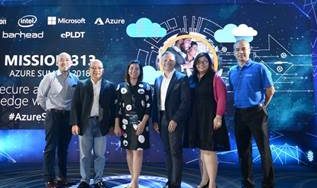
    (from L-R) Microsoft Philippines COO Christian Lim, James Indino – VP-IT of Philcare, Marian Lontoc – IT Sales Director – Crayon, Andres Valencia – Global VP of ISV and Verticals, Crayon, Dir Angel Magtalas – ICTSS, Dept of Budget and Management, and Microsoft Philippines Managing Director Hans Bayaborda.

    The first ever Azure Summit in the Philippines was given a warm Filipino welcome as it was attended by over 900+ IT/Data Pros delegates, eager to see how organizations are using technology to change the game. Microsoft also gave away 25 Azure certifications to enable even more organizations through the cloud.