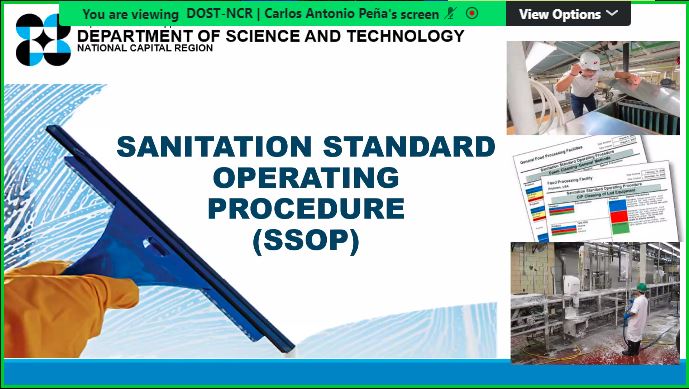
Department of Science and Technology (DOST) – National Capital Region (NCR) has conducted a FoodBitz Webinar on Basics of Sanitation Standard Operating Procedures (SSOP) on February 11, 2025, Thursday, 9:00 AM to 12:00 PM., Virtual via Zoom Teleconference, with Resource Speaker, Mr. Carlos Antonio M. Pena, PFT, Science Research Specialist II, DOST-National Capital Region.
I participated the DOST-NCR (Foodbitz Webinar) to gain insights and knowledge about the Basics of Sanitation Standard Operating Procedure (SSOP).
The SSOP Learning Objectives are as follows:
Understand basic principles of cleaning and sanitation.
Appreciate the role of SSOP in food safety management systems.
Enumerate sanitation controls.
Draft a sample SSOP and SSOP plan.
Identify and understand SSOP components.
The Topic Outline includes:
I. SSOP in food safety management system.
II. Basic principles in cleaning and sanitation.
III. Sanitation controls.
IV. SSOP control checks and verification.
V. SSOP development and SSOP plan.
Sanitation Standard Operating Procedure (SSOP) is a detailed written procedures that describe cleaning and sanitation procedures and practices that an establishment develops and implements to prevent direct contamination or adulteration of products (USDA, 2023).
In the webinar, I’ve learned the importance of cleaning and sanitizing in Food Establishments. Cleaning removes visible contamination such as food waste, dirt and grease from a surface. In sanitizing, Sanitation kills microorganisms, thereby reducing the numbers of microorganisms present on a surface.
The DOST-NCR issued a Certificate of Participation for participating in “Sanitation Standard Operating Procedures” conducted on February 11, 2025 via Zoom Videoconferencing Application.
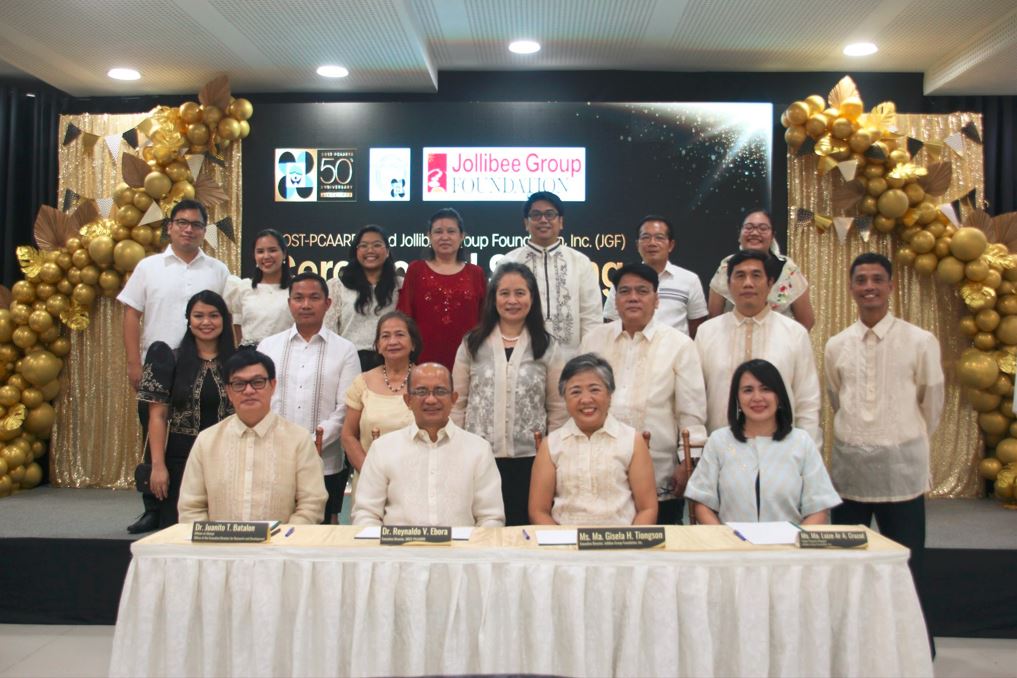
Jollibee Group Foundation (JGF), the social development arm of Jollibee Group, and the Department of Science and Technology – Philippine Council for Agriculture, Aquatic, and Natural Resources Research and Development (DOST-PCAARRD) recently signed a Memorandum of Understanding, which aims to further enrich their efforts in developing the entrepreneurial capacity of smallholder producers and link to agriculture value chains.
“This partnership is an important milestone for farmer entrepreneurs. PCAARRD’s expertise in research and development in agriculture will surely help create access to more technologies that can enhance farmers’ livelihood to become more profitable,” said Gisela Tiongson, executive director of JGF.
The agreement between DOST-PCAARRD and JGF focuses on further promoting sustainable agricultural practices through technology transfer, access to knowledge, and tools to enhance productivity. It also aims to improve research and development activities to bring forth science and technology-based solutions for agri-aqua enterprises. The program also includes networking and market linkages to ensure the viability of agro-enterprises.
Partnership for Agro-Entrepreneurship. The MOU signing was held at the DOST-PCAARRD Innovation and Technology Center in the presence of (seated, from left): (place names in this sequence for easier read) JGF Executive Director Gisela Tiongson (seated, third from left); JGF Senior Program Manager Ma Laize Ar Cruzat (seated, fourth from left); DOST-PCAARRD Executive Director Dr. Reynaldo V. Ebora (seated, second from left); and DOST Undersecretary Leah J. Buendia (seated, first from left).
Of this, DOST-PCAARRD Executive Director Dr. Reynaldo V. Ebora said, “We believe that this partnership for agro-entrepreneurship will strengthen PCAARRD’s efforts in addressing technology gaps to improve quality and productivity, as well as in building the capacities of farmer groups and partner LGUs to provide opportunities to tap institutional markets. We are also certain that this will pave the way to strengthen the implementation of projects and activities with the end goal of achieving JGF’s mission and PCAARRD’s mandates.”
This initiative also supports JGF’s Farmer Entrepreneurship Program (FEP), which empowers and helps smallholder farmers sharpen their technical and business acumen, as well as partnership-building skills. FEP uses the Agro-Enterprise Clustering Approach to assist farmer groups supplying Jollibee Group and other markets.
To date, Jollibee Group has accredited 18 farmer groups across the country that supply more than 9,000 metric tons of vegetables to the company, which accounts for more than P360 million in total sales.
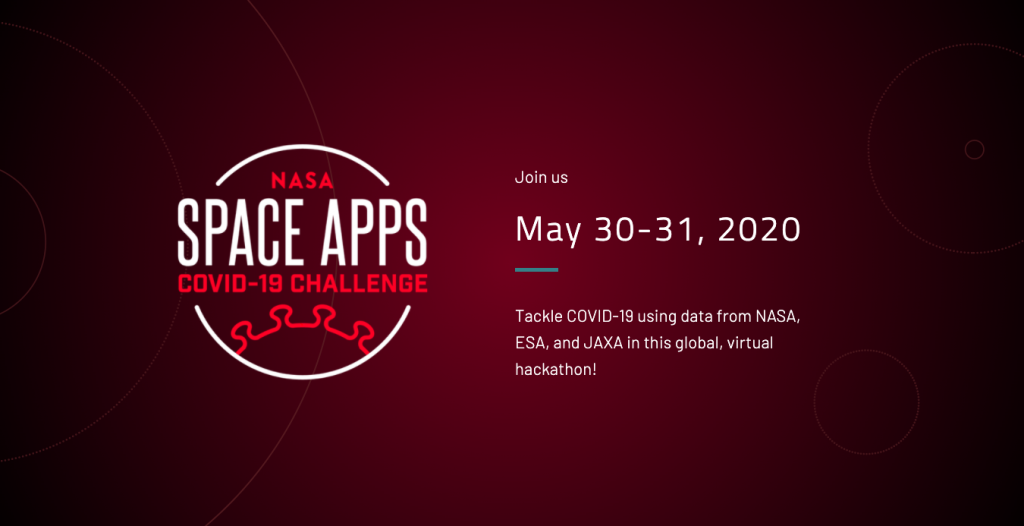
The U.S. space agency National Aeronautics Space Administration (NASA), European Space Agency (ESA), and Japan Aerospace Exploration Agency (JAXA) are inviting coders, entrepreneurs, scientists, designers, storytellers, makers, builders, artists, and technologists to participate in a virtual hackathon May 30-31 dedicated to putting open data to work in developing solutions to issues related to the COVID-19 pandemic.
During the global Space Apps COVID-19 Challenge, participants from around the world will create virtual teams that – during a 48-hour period – will use Earth observation data to propose solutions to COVID-19-related challenges ranging from studying the coronavirus that causes COVID-19 and its spread to the impact the disease is having on the Earth system. Registration for this challenge opens in mid-May.
“There’s a tremendous need for our collective ingenuity right now,” said Thomas Zurbuchen, associate administrator for NASA’s Science Mission Directorate. “I can’t imagine a more worthy focus than COVID-19 on which to direct the energy and enthusiasm from around the world with the Space Apps Challenge that always generates such amazing solutions.”
The unique capabilities of NASA and its partner space agencies in the areas of science and technology enable them to lend a hand during this global crisis. Since the start of the global outbreak, Earth science specialists from each agency have been exploring ways to use unique Earth observation data to aid understanding of the interplay of the Earth system – on global to local scales – with aspects of the COVID-19 outbreak, including, potentially, our ability to combat it. The hackathon will also examine the human and economic response to the virus.
ESA will contribute data from the Sentinel missions (Sentinel-1, Sentinel-2 and Sentinel-5P) in the context of the European Copernicus program, led by the European Commission, along with data from Third Party contributing Missions, with a focus on assessing the impact on climate change and greenhouse gases, as well as impacts on the economic sector. ESA also is contributing Earth observation experts for the selection of the competition winners and the artificial-intelligence-powered EuroDataCube.
“EuroDatacube will enable the best ideas to be scaled up to a global level,” said Josef Aschbacher, director of Earth Observation Programmes at ESA. “The pandemic crisis has a worldwide impact, therefore international cooperation and sharing of data and expertise with partners like NASA and JAXA seems the most suitable approach.”
JAXA is making Earth observing data available from its satellite missions, including ALOS-2, GOSAT, GOSAT-2, GCOM-C, GCOM-W, and GPM/DPR.
“JAXA welcomes the opportunity to be part of the hackathon,” said JAXA Vice President Terada Koji. “I believe the trilateral cooperation among ESA, NASA and JAXA is important to demonstrate how Earth observation can support global efforts in combating this unprecedented challenge.”
Space Apps is an international hackathon that takes place in cities around the world. Since 2012, teams have engaged with NASA’s free and open data to address real-world problems on Earth and in space. The COVID-19 Challenge will be the program’s first global virtual hackathon. Space Apps 2019 included more than 29,000 participants at 225 events in 71 countries, developing more than 2,000 hackathon solutions over the course of one weekend.
Many Filipinos participated in this annual hackathon since 2016. Recently, a dengue mapping forecasting system was developed by data scientists from CirroLytix using satellite and climate data with the goal of addressing the sustainable development goals of the United Nations. This web application, called Project AEDES won globally for the best use of data. “Earth observation data has the potential to be used in fighting epidemics and outbreaks threatening humanity nowadays, as well as to analyze its socio-economic impact,” according to software developer Michael Lance M. Domagas, who led the Philippine hackathon in collaboration with De La Salle University, PLDT, Department of Science and Technology, United Nations Development Programme, and the U.S. embassy. The very first Philippine winner used citizen science and environmental data to develop a smartphone application informing fishermen the right time to catch fish. ISDApp is currently being incubated at Animo Labs.
Space Apps is a NASA-led initiative organized globally in collaboration with Booz Allen Hamilton, Mindgrub and SecondMuse. The next annual Space Apps Challenge is scheduled for October 2-4.