Tag: CirroLytix

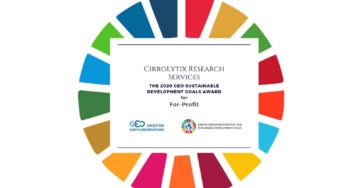
  • Filipino startup recognized in addressing SDG’s using space tech

    Filipino startup recognized in addressing SDG’s using space tech

    The Undersecretary for Competitiveness and Innovation of the Department of Trade and Industry (DTI) Dr. Rafaelita “Fita” M. Aldaba heartfeltly congratulates CirroLytix. “It’s indeed a blessing amid this pandemic and economic crisis that we are currently faced with,” she said.

    The award-winning startup continues to update the AEDES framework to include socio-economic risk mapping to turn it into a health and environmental policy tool. Aside from dengue, the company also supports COVID-19 modeling and response initiatives with the public health sector. CirroLytix’s current involvements include public health, human rights, fighting disinformation, education and food security.

    The Space Apps lead organizer in the Philippines Michael Lance M. Domagas appeals support for these Filipino winners. “How many times should these Filipino innovators and achievers need to win before being recognized and appreciated by our own country? To be recognized by not just one, but five space agencies is something has not yet been achieved by Filipinos, how much more of a multitude of countries and nations supporting the sustainable development goals of the United Nations?” He added that “The dengue epidemic and the COVID-19 is a real threat to the Philippine society right now, endangering health, well-being, livelihood, and most especially businesses and the national economy. If we could only learn how to give value to science, technology, mathematics, and engineering (STEM), the possibilities are endless. Our Filipino winners of Space Apps and GEO SDG Awards have taught us on how these space technologies greatly help in addressing epidemics and economic impact of COVID-19, its time to give them recognition and respect because they are Filipinos like us.” Winners shall be invited to visit NASA once travel is deemed safe, but unfortunately, travel, meals and incidental expenses, and accommodation expenses are not provided.

    On the other hand, Cirrolytix encourages the use of data in addressing social problems and issues surrounding the Bangsamoro region. Together with the Asia Foundation and Data Ethics PH, the online Bangsamoro Data Challenge invites ages 15 years old and above to develop data-driven solutions in helping the region. Deadline for registration is on Saturday 11:59pm, November 21, 2020 at https://barmm.opendata.org.ph/

    The Group on Earth Observations (GEO) is a partnership of more than 100 national governments and in excess of 100 participating organizations that envisions a future where decisions and actions for the benefit of humankind are informed by coordinated, comprehensive and sustained Earth observations.

    About 2020 GEO SDG Awards

    The 2020 Group on Earth Observations Sustainable Development Goals (GEO SDG) awards program, in its second year, is led by the international Earth Observations for the Sustainable Development Goals (EO4SDG) initiative and recognizes excellence in sustainable development practices, analysis and reporting through the use of Earth observations. The awards honour productivity, ingenuity, proficiency, novelty, and exemplary communications of results and experiences in the use of Earth observations for the Sustainable Development Goals.

    About Group on Earth Observations

    The Group on Earth Observations (GEO) is a partnership of more than 100 national governments and in excess of 100 participating organizations that envisions a future where decisions and actions for the benefit of humankind are informed by coordinated, comprehensive and sustained Earth observations.

    About Space Apps

    Now in its 9th year, the National Aeronautics and Space Administration’s (NASA) International Space Apps Challenge is an international hackathon for coders, scientists, designers, storytellers, makers, builders, technologists, and others around the world, where teams engage with NASA’s free and open data to address real-world problems on Earth and in space. Space Apps 2019 included over 29,000 participants in 71 countries. In May 2020, the virtual-only Space Apps COVID-19 Challenge concluded with over 15,000 participants from 150 countries. Space Apps is a NASA-led initiative organized in collaboration with Booz Allen Hamilton, Mindgrub, SecondMuse, and the NASA Open Innovation Applied Sciences Program.

    About CirroLytix

    CirroLytix Research Services is a social impact data analytics company. Their mission is to help governments, non-profits, researchers, international and local organizations succeed at addressing collective social problems around the world by harnessing the full power of their data. The ultimate contribution to society is in enabling social impact professionals and entities make positive data-driven change on the lives they seek to uplift.

    For media inquiries, please contact
    Michael Lance M. Domagas

    Lead organizer NASA’s International Space Apps ChallengeManila, Philippinescatch2t8@yahoo.com.ph
    #GEOAwards #GEOWeek2020 #EO4SDG #SpaceApps #SpaceAppsPH
  • Pinoy app addressing pandemic impact won the Space Apps COVID-19 Challenge

    Pinoy app addressing pandemic impact won the Space Apps COVID-19 Challenge

    An integrated public policy information portal measuring the impact of the coronavirus pandemic developed by Filipinos won the Space Apps COVID-19 Challenge in the best use of data, the solution that best makes space data accessible, or leverages it to a unique application. Using Earth observation, in-country economic and human mobility data, and global infection case counts, data analysts Nick Tobia, Helen Mary Barrameda, Kristel Joyce Zapata, Theresa Rosario Tan, and Miguel Oscar Castelo from CirroLytix created a dashboard for policy makers and economic planners to show the impact of COVID-19 on various countries and effects on the economy and environment.

    Named G.I.D.E.O.N. (Global Impact Detection from Emitted Light, Onset of Covid-19, and Nitrogen Dioxide), the portal uses news feeds, Google mobility data, and coronavirus cases revealing the multi-dimensional impact of lockdown and other interventions. Night lights from the Visible Infrared Imaging Radiometer Suite (VIIRS) and nitrogen dioxide levels from Sentinel-5P show current impacts and forecast effects of lockdown. Google’s community mobility reports, global infection data from Johns Hopkins University, and nitrogen dioxide data reveal pollution levels produced by human activity, and monitor which countries keep air quality under control as they bounce back from lockdown and pave the way for the “new normal.”

    Data analysts Nick Tobia, Kristel Joyce Zapata, Theresa Rosario Tan, Miguel Oscar Castelo, and Helen Mary Barrameda from CirroLytix won the Space Apps COVID-19 Challenge.

    Aside from having a global winner, two Pinoy teams made it as global finalists too.

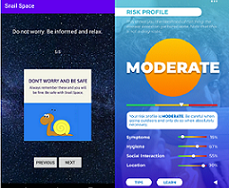
    Inspired by social isolation experienced by astronauts in space, Snail Space (A wordplay for snail’s pace) is an app giving a “safe space” by providing mental care and comfort during times of social isolation brought by COVID-19 pandemic. It was developed by Celestial Snails team comprised of Arturo Caronongan III, Kevin Olanday, In Yong Lee, Mary Anne Dominique Casacop, and Gabriel Santiago from De La Salle University.

    Text Box: Pinoy global finalists Celestial Snails addressing social isolation and Sentinellium predicting developing epidemics.With public health in mind, Sentinellium leverages user data sent through SMS and chat, and space assets like population density, urbanization, and aerosol to provide a more accurate prediction of developing epidemics. This was done by Harlee Quizzagan, James Andrew C. Cornes, Angela Chua, Alaica Mariño, Joal Rose Lin, and Mohammad Ashraful Mobin, in which their group was formed during the hackathon period.

    “The use of these modern and advanced technologies will be crucial, especially as the world navigates the fourth industrial revolution. Using big data, cloud, and AI applications for instance, could help us understand the severity of the disease and aid in delivering measures to mitigate its impact,” according to the Undersecretary for Competitiveness and Innovation of the Department of Trade and Industry (DTI) Dr. Rafaelita “Fita” M. Aldaba. “This really fills me with great optimism that our young and talented startups and Filipinos have so much to offer and contribute to our efforts to provide solutions to address health and economic crisis,” she said.

    Last May 30-31, 2020, coders, entrepreneurs, scientists, designers, storytellers, makers, builders, artists, and technologists have been invited in an all-virtual, global hackathon by the United States space agency National Aeronautics Space Administration (NASA), along with the European Space Agency (ESA), Japan Aerospace Exploration Agency (JAXA), the National Centre for Space Studies (CNES) of France, and Canadian Space Agency (CSA). During a period of 48 hours, more than 15,000 participants from 150 countries created more than 2,000 virtual teams. Participants used Earth observation and other open data to propose solutions to one of twelve challenges related to the COVID-19 pandemic.

    Pinoy mentors during the hackathon. Top: Michael Lance M. Domagas, Elymar Apao, and Janyl Tamayo. Middle: Chi Señires, Aldrich Tan, and Andresito de Guzman. Bottom: Dominic Vincent Ligot.

    During the virtual bootcamp one week prior to the hackathon, Ellison Castro, Cara Patricia Canlas, and Arlo Jayson Sabuito from STAMINA4Space discussed the capabilities of microsatellites in determining the height of clouds and forest fire mapping using support vector machine. During the hackathon, Aldrich Tan, Elymar Apao, Chi Señires, and Janyl Tamayo from UXPH helped participants in designing and bringing user experience to their projects. Andresito de Guzman of PWA Pilipinas taught participants on developing progressive web applications. 2019 global winner in the best use of data Dominic Vincent Ligot from the Analytics Association of the Philippines and Data Ethics PH brought inspiration by emphasizing the importance of data analytics for social good.

    G.I.D.E.O.N. is one of the six global winners selected by NASA, ESA, JAXA, CSA, and CNES, and one of the three teams shall have special access to the Euro Data Cube environment. If travel is deemed safe, winners shall also be invited to visit a NASA site to view a spacecraft launch. However, travel, accommodation, and food costs are not included. Lead organizer Michael Lance M. Domagas appeals support for the current and past winners, finalists, and especially to the four-year community who worked so hard in bringing honor for the country. “After being recognized by five leading space agencies of the planet, its time for our own country to show appreciation and give support for those who are stepping forward in combating the COVID-19 pandemic and its effects in our society today to defeat our common enemy,” he said.

    Top: 2019 winner Dominic Vincent Ligot, Nick Tobia from G.I.D.E.O.N., and Harlee Quizzagan from Sentinellium. Bottom: Lead organizer Michael Lance M. Domagas, and Arturo Caronongan III from Celestial Snails.

    Previous Pinoy hackathon winners are Project AEDES (2019), using satellite and climate data to pinpoint possible dengue hotspots, and ISDApp (2018), which uses citizen science data to inform fishermen the right time to catch fish.

    The Space Apps COVID-19 Challenge is a special edition of NASA’s annual Space Apps Challenge, an international hackathon that takes place around the world and online every October. Since 2012, teams have engaged with NASA’s free and open data to address real-world problems on Earth and in space. Space Apps 2019 included more than 29,000 participants in 71 countries, developing more than 2,000 hackathon solutions over one weekend. This NASA-led initiative is organized in collaboration with Booz Allen Hamilton, Mindgrub, and SecondMuse. The next annual Space Apps Challenge is scheduled for October 2-4, 2020 in a virtual format. Registration opens August 15: https://2020.spaceappschallenge.org/locations/manila

    About Space Apps

    Now in its 9th year, Space Apps is an international hackathon for coders, scientists, designers, storytellers, makers, builders, technologists, and others in cities around the world, where teams engage with the National Aeronautics and Space Administration’s free and open data to address real-world problems on Earth and in space. Space Apps 2019 included over 29,000 participants in 71 countries. In May 2020, the virtual-only Space Apps COVID-19 Challenge concluded with over 15,000 participants from 150 countries. Space Apps is a NASA-led initiative organized in collaboration with Booz Allen Hamilton, Mindgrub, SecondMuse, and the NASA Open Innovation Applied Sciences Program.

    For media inquiries, please contact:

    Michael Lance M. Domagas

    Lead organizer

    NASA’s International Space Apps Challenge

    Manila, Philippines

    catch2t8@yahoo.com.ph

    #SpaceApps #SpaceAppsPH