Category: Home & Living

  • ASIA: The World’S Skyscraper Capital

    ASIA: The World’S Skyscraper Capital

    Global property portal looks at region’s sky-high towers.

    Home to the bulk of the tallest towers on the planet, Asia is without a doubt the world’s skyscraper capital. From Dubai to Shanghai, the region dominates the list of the world’s supertall buildings.

    Of the top 10 tallest towers around the world, just two – the recently completed One World Trade Centre in New York City and the Willis Tower in Chicago – are located outside Asia and the Middle East.

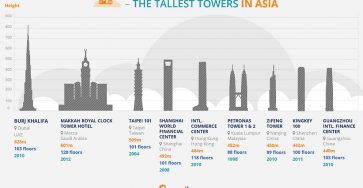
    Stacked one on top of the other, the 10 tallest towers in Asia would measure more than five km into the sky. These top 10 tallest towers are shown on a new infographic, released by global property portal Lamudi.

    With its towering commercial centres and tendency towards high-density living, China leads the world in skyscraper construction. Of the record-breaking 97 buildings measuring 200 meters high or taller that were completed around the world in 2014, 58 of these were located in China. This represents roughly 60 percent of the global total, according to figures recently released by the Council on Tall Buildings and Urban Habitat.

    The city of Dubai currently holds the title for the world’s tallest skyscraper. Reaching 829.8m high, the Burj Khalifa is the tallest artificial structure on earth. For those without a serious fear of heights, the super tower is also home to the world’s highest observation deck, located on the 148th floor.

    The Makkah Royal Clock Tower Hotel in Mecca, Saudi Arabia, is the region’s second tallest tower. Located close to the world’s largest mosque, Masjid al-Haram, the five-star hotel is designed to cater for Muslim pilgrims visiting the holy city. The structure has 76 state-of-the-art elevators offering easy access to the mosque for prayers.

    In third place is Taipei 101 in Taiwan, which stands at 508m and was once the tallest building in the world. The skyscraper’s unique design is based on the number eight, which is considered lucky in Chinese culture. The design was chosen to withstand the earthquakes and typhoons that are common in the country.

    Elsewhere in Asia, the Shanghai World Financial Center, the International Commerce Centre in Hong Kong and the Petronas Towers in Malaysia also make the top 10 list.

    Currently under construction in China is the 632m Shanghai Tower which, once completed later this year, will be the world’s second tallest building. However, at 660m, the Ping An Finance Centre in Shenzhen will overtake the Shanghai Tower in 2016.

    Set to reach 1km into the sky, the Kingdom Tower in Saudi Arabia will take the title of the world’s tallest building once it is completed in 2019.

    ABOUT LAMUDI

    Launched in 2013, Lamudi is a global property portal focusing exclusively on emerging markets. The fast-growing platform is currently available in 28 countries in Asia, the Middle East, Africa and Latin America, with more than 800,000 real estate listings across its global network. The leading real estate marketplace offers sellers, buyers, landlords and renters a secure and easy-to-use platform to find or list properties online. For more information, please visit http://www.lamudi.com.ph

    Visit  Lamudi Philippines on  Facebook, Twitter, Google+ and LinkedIn.

    REFERENCE & MEDIA CONTACT

    Rodel Ambas

    Head of Content and PR, Lamudi Philippines

    Email: rodel.ambas@lamudi.com.ph Phone: +63 917 3015127

  • Infographic: What will your house look like in 10 years?

    Infographic: What will your house look like in 10 years?

    Smart home technology gaining traction in emerging markets.

    From the moment you wake up in the morning, the house reacts to your needs. The automated lights turn on slowly to wake you up at a scheduled time. From the comfort of your bed, you switch on your coffee machine so your morning cup is fresh and hot by the time you arrive downstairs for breakfast.

    You enter the bathroom and stand in front of your intelligent mirror. The mirror’s reflective surface springs to life with all the information you need to kick-start your day, including the weather and the morning’s top news. The device also plays your favourite music so you are always guaranteed to start the day in a good mood.

    After getting ready, you go to the kitchen for breakfast where your smart refrigerator alerts you that you are nearly out of milk. With the tap of a finger on the fridge’s touch screen, you can restock your fridge and order all your groceries for the week through an online store.

    The infiltration of technology to assist with these small daily tasks may just be the beginning. The fully-connected home is designed to boost energy efficiency, protect against intruders and even monitor your family’s health. With the rapid growth in the home automation industry, so-called smart home systems have already hit the mainstream – although the high cost of such devices keeps them out of reach for many. But there are signs that this is about to change.

    This year, revenue from the smart home market is expected to exceed $US48 billion, according to recent Strategy Analytics forecasts. By 2019, the sector’s market revenue will increase to $115 billion. By the end of this decade, nearly 12 percent of global households will have at least one type of smart system installed. In fact, Tony Fadell, the CEO of Nest – the connected homes product company that was bought by Google earlier this year – has predicted that within a decade, every electrical device in your home will be connected to the internet.

    While the smart home market is quickly gaining traction in developed countries, there are now signs that the trend is spreading to the emerging markets. Consumers in the Asia Pacific region has been particularly keen to embrace the new connected technologies, as tech companies begin to acknowledge the opportunities in this sector.

    Connected home firm Icontrol Networks expanded to Asia in October, with the company partnering with a Japanese cable provider to offer a smart home system that consumers can install themselves. This month, Chinese electronics firm Xiaomi invested 1.26 billion yuan (about $200 million) in home appliance company Midea, as it looks to expand into the smart homes market.

    Lamudi’s Global Co-Founder and Managing Director, Kian Moini, said: “The smart home concept is all about making living much more comfortable, as well as more efficient, which means that the concept has universal appeal. As prices come down in the coming years and people worldwide begin to focus more on issues such as energy saving, we expect to see this trend sweep the emerging markets as well.”

    REFERENCE & MEDIA CONTACT

    Rodel Ambas
    Head of Content and PR, Lamudi Philippines
    Email: rodel.ambas@lamudi.com.ph
    Phone: +63 917 3015127

  • Affordability Key Deterrent from Buying Property: Report

    Global property portal releases new research on real estate in the Philippines.

    Affordability is top of mind for Filipinos who choose not to buy property, with more than 60 percent of renters in a recent survey of online house-hunters citing cost constraints as the primary reason they leased their home.

    The findings are contained in new research from global property website Lamudi, which today released its first report on real estate in the emerging markets. The report, Real Estate in the Emerging Markets, provides a comprehensive overview of the property sector in 16 emerging countries, including the Philippines.

    The report is based on a series of online surveys conducted with house-hunters and real estate agents in each country, as well as onsite data from Lamudi’s global network of websites. The research examines the habits of online property-seekers, while offering insights into the future of the property sector based on interviews and surveys with local property experts.

    The customer survey examined house-hunting habits among buyers and renters. For renters, affordability emerged as the key reason why many Filipinos choose not to buy their own home. More than 60 percent of renters surveyed said they could not afford to buy property. For buyers, the main driver for owning property is security. Nearly three-quarters of buyers cited security as their primary motivation for purchasing a home.

    According to the survey of real estate agents, the country’s economic outlook is seen as the top constraint on the property market, reflecting current concerns about a potential slowdown. However, agents and brokers remain overwhelmingly optimistic about the future of the market. More than 90 percent describe their outlook for the next 12 months as positive.

    Lamudi’s Global Co-Founder and Managing Director, Kian Moini, said: “The primary conclusion that we have drawn from our research is that the future for the Philippine property sector is extremely bright. In fact, two-thirds of the real estate agents we surveyed are expecting growth of eight percent or higher in the property market this year. The country’s real estate market has emerged as one of the most promising in the Asia Pacific region.”

    The report features a series of in-depth interviews with key figures from the property industry of each country, including Jose Romarx Salas, Head of Research and Consulting at Pinnacle Real Estate Consulting Services.

    Mr Salas said the key challenge for the Philippine property market was finding enough land to accommodate development. “In Metro Manila, that’s the challenge: looking for suitable land. Some developers are even willing to bid high, which pushes up already skyrocketing land prices in the capital,” he told Lamudi.

    The 16 countries covered in the report are: Indonesia, the Philippines, Myanmar, Bangladesh, Pakistan, Sri Lanka, Jordan, Saudi Arabia, Nigeria, Kenya, Tanzania, Morocco, Ghana, Ivory Coast, Mexico and Colombia.

    The full report is presented in an easy-to-read online format, available for viewing on the Lamudi website. Visit www.lamudi.com.ph/research.

    ABOUT LAMUDI

    Launched in 2013, Lamudi is a global property portal focusing exclusively on emerging markets. The fast-growing platform is currently available in 28 countries in Asia, the Middle East, Africa and Latin America, with more than 750,000 real estate listings across its global network. The leading real estate marketplace offers sellers, buyers, landlords and renters a secure and easy-to-use platform to find or list properties online. For more information, please visit http://www.lamudi.com.ph

    Visit Lamudi Philippines on Facebook, Twitter, Google+ and LinkedIn.

    REFERENCE & MEDIA CONTACT

    Rodel Ambas
    Content Editor, Lamudi Philippines
    Email: rodel.ambas@lamudi.com.ph
    Phone: +63 917 3015127

  • Pros and Cons: Foreign property ownership in the Philippines

    Lamudi takes a look at the advantages and disadvantages of allowing foreign property ownership in the Philippines.

    To say that Philippine real estate is fast becoming a favorite among buyers abroad is quite an understatement. In fact, an article published in ABS-CBNnews.com reported that Asian investors—from Malaysia to Japan—are snapping up condo units in bulk. These buyers are favoring the Philippines over Hong Kong and Singapore, where the authorities have put in place cooling measures to rein in property prices.

    “There has never been this strong interest in the Philippine property market,” said Colliers International’s David Young in an interview. But despite this, the Philippines still does not allow foreign ownership of real property; foreigners, however, can purchase condo units so long as foreign ownership in a single project does not exceed 40 percent.

    This may seem counterintuitive, because more established property markets allow freehold foreign ownership of real estate to attract investment and create more wealth. Hence, it makes sense for the Philippines to follow suit. By doing the opposite the Philippines may be thwarting its competitiveness.

    To look into this issue closely, Lamudi Philippines compiled a list of the pros and cons of allowing foreign ownership of real property in the country.

    PROS

    1. Foreign Investment on Real Estate Will Boost the Market

    The residential real estate market will get a boost if some of the restrictions imposed on foreigners are lifted, said David Leechiu, JLL Philippines Managing Director and Country Manager.

    In an interview with the Philippine Daily Inquirer, Leechiu said that the total worth of the Philippine real estate industry could jump from $48 billion reported in 2011 to $300 billion by 2031, if certain structural changes were made, such as relaxing rigorous rules on foreign ownership and longer lease terms.

    Although the Philippines’ macroeconomic fundamentals are sound, Leechiu said it could do so much better if it were less restrained.

    2. The Country May Benefit from More Substantial Investment

    According to Charlie Gorayeb, Chairman of the Chamber of Real Estate & Builders’ Association (CREBA), foreign investment into real estate will attract much-needed capital, which will unleash the multiplier effect of construction and real estate sectors into other industries. This multiplier effect will impact sectors closely related to real estate, and will provide additional opportunities for local businesses and employment.

    3. Benefits Will Spill Over to Other Sectors

    For many years the Philippines has lagged behind its neighbors in Southeast Asia when it comes to attracting foreign direct investment. According to experts, this is due in part to the country’s restrictive business climate, particularly when it comes to foreign ownership of properties. Allowing foreigners to own land for industrial and commercial purposes will benefit the manufacturing sector, which will boost employment opportunities for many Filipinos.

    Cons

    1. It May Cause Property Prices to Skyrocket

    In certain cases, allowing foreign money to come in freely is not entirely a good thing. For example, London has become too attractive to rich property buyers from Russia and the Middle East, which drove prices too high and priced locals out of the housing market. At the moment prices of houses and condos in Metro Manila are already beyond the reach of most Filipinos, so allowing foreigners to freely purchase may push prices even higher.

    2. It May Spur Speculative Purchases

    Speculative purchase of property—the kind that take large risks in the hope of making quick, huge gains—could be intensified when the gates are opened to foreign property buyers. This could pose danger to the real estate market, which could go through a period of irrational exuberance, fueling the formation of a real estate bubble.

    3. Lands Acquired by Foreigners May Be Converted for Another Purpose

    There are certain property types that if they get sold and converted into another use may do more harm than good to the local economy. Examples of these properties are agricultural land. According to Gorayeb, there should be some mechanisms of control to protect local interest. Agricultural lands, for example, should remain as such even when they are purchased by foreigners, and in order to protect our natural resources foreigners should only be allowed to purchase disposable or alienable land.

    REFERENCE & MEDIA CONTACT

    Rodel Ambas

    Content Editor, Lamudi Philippines

    Email: rodel.ambas@lamudi.com.ph

    Phone: +63 917 3015127

  • Five Questions every OFW should ask before buying a property

    With the Christmas season fast approaching, many overseas Filipino workers are readying their hard-earned cash to purchase their first home.

    They say that Christmas is the season of giving. But for many overseas Filipino workers (OFW) returning home for the holidays, it is also the season for some serious home shopping.

    In fact, according to Enrique Soriano III, Program Director for Real Estate at the Ateneo de Manila University–School of Business, many OFWs spend all year saving enough down-payment cash for their first home, and they usually remit this cash by December when their purchase decisions are finally made.

    An observation Claro dG. Cordero, Head of Research, Consulting, and Valuation at JLL Philippines, shares: “More property transactions occur at the end of the year when many of these OFWs have performed oculars of the properties they’re looking into buying.”

    With the Christmas season fast approaching, a great number of OFWs are already researching on their home purchase, and come December, many of them would be ready to buy. However, since a home is perhaps the most important purchase any person can make, it only make sense that due diligence should be made.

    Lamudi Philippines has compiled the following questions to ask to make the decision easier for every OFW.

    1. What do I Intend to do with the Property?

    Will the property be used a primary residence for the OFW family or an income-generating asset? The OFW must first determine this in order to inform his or her decision on what type of property to buy, where to buy, and even when to buy.

    When looked from the financial perspective, a home purchase makes a lot sense if the property will be used as the primary residence of the OFW family. Hence, the property should meet the requirements of the OFW’s family (size, location, type, etc.). Buying a home will give the OFW and his family a sense of financial security and watch their investment grow in the long term through capital appreciation.

    However, buying property strictly as an income-generating asset presents a different challenge, which will be tackled in the next item.

    1. Who Will Manage the Property?

    If the OFW is buying a property to eventually have it rented out, then it is a different matter. A crucial question to ask should be, “who will manage the property while the OFW is out of the country.”

    If the property is in Metro Manila and the OFW’s family lives in the province, then it will make sense to hire an agent that will double as a property manager. They will take care of finding and screening prospective tenants, scheduling viewings, collecting rent, and overseeing the property’s upkeep, among many others. According to Angela Manese, Residential Division Manager at estate agent KMC MAG Group, it is very crucial who looks after the property while the OFW is away. After all, that person will be key to making the investment property a profitable one.

    1. Which Developer to Choose?

    They say that due diligence can go a long way, especially if the OFW is buying a preselling property. Hence the importance of choosing the property developer cannot be overemphasized.

    An OFW buyer can count on an established, publicly listed developer to deliver on its promise because it has a reputation to protect. In addition, established developers are generally well funded, so they are highly unlikely to default.

    1. Should I Inspect the Property?

    Whether it is a condominium in Makati or a house in Cavite, make sure that you have physically inspected the property before buying it.

    Although this may mean making a trip or two back home, but the cost would be worth it. A homebuyer who does not inspect the property runs the risk of discovering major defects at a point when the deed of sale has already been signed—and the property can no longer be returned.

    However, some OFWs will have to make do with asking someone they trust (a close relative, for instance) to do the inspection for them. If possible, make a to-do list for the appointed inspector, and even ask the person to send pictures or even videos of the property.

    1. Should I Ready Extra Cash for the Closing Costs?

    When buying a piece of real estate, the seller takes care of the capital gains tax and the broker’s commission, while the home-buyer takes care of the documentary stamps tax (1.5 percent of the property’s selling price), transfer tax (0.5–0.75 percent of selling price), registration fee (Php8,796 for properties whose selling price is Php1.7 million or lower, plus an additional Php90 for every Php20,000 in excess of Php1.7 million), and notarial fee (1–1.5 percent of the property’s selling price).

    For example, an OFW buying a Php1.7 million property needs to ready approximately Php59,800 for the closing costs.

    REFERENCE & MEDIA CONTACT
    Rodel Ambas
    Content Editor, Lamudi Philippines
    Email: rodel.ambas@lamudi.com.ph
    Phone: +63 917 3015127

  • Crosswinds Swiss Luxury Resort is the  dog-friendly resort in Tagaytay

    Crosswinds Swiss Luxury Resort is the dog-friendly resort in Tagaytay

    Pet lovers who wish to share a peaceful, beautiful environment with their canine companions would do well to visit Crosswinds Swiss Luxury Resort, which is 100-hectares of lush green residential resort property set in one of the highest and breeziest areas of Tagaytay, with more than 23,000 pine trees filling the air with their fresh, sweet scent. The architecture of Crosswinds takes inspiration from the picturesque chalets of Switzerland. This haven of fresh breezes, pine trees, and breath-taking views hosted an event exclusive for dog lovers and their four-legged friends belonging to the Cavite Canine Club.

    Participants at the dog show organized by The Cavite Canine Club get their entries in the Group 6 –Beagle category ready for competition. The dog show was held at the Crosswinds Swiss Luxury Resort in Tagaytay.
    Dog show officials_Maribel S; Ekarat Sangkunakup (Thailand); Dr. Jose Mendiola (Phl); and Dr. Andi Hudono (Indonesia) pose for posterity during a break from the competition. The event was organized by The Canine Club of Cavite and held at the Crosswinds Swiss Luxury Resort in Tagaytay.

    The Cavite Canine Club held its all-breeds dog shows—the 123rd, 124th, and 125th–at the Crosswinds, with more than 250 dogs participating in each show. Participants from all over the Philippines joined the shows, which were officiated by Mr. Ekarat Sangkunakup from Thailand; Dr. Andi Hudono from Indonesia; and Dr. Jose Mendiola from the Philippines.

    Different canine breeds were featured in the competition including American Cockers; Golden Retrievers; Labrador Retrievers; Jack Russell Terriers; Beagles; Chihuahuas; Pekingese; French Bulldogs; Pugs; Shih Tzus; Boxers; Bulldogs; Dobermans; Great Danes; Minipins; Chowchows; Pomeranians, and Siberian Huskies.

    This glamorous Standard (Not French)Poodle received the BIS3 prize in the dog show organized by The Canine Club of Cavite. Also in the photo are Maribel Sy; Dr. Andi Hudono; Handler JR; and Dr. Jose Mendiola. The event was held at the Crosswinds Swiss Luxury Resort in Tagaytay.

    Amid the verdant, picturesque setting provided by Crosswinds and the fellowship, goodwill, and camaraderie among the participants, everyone had an enjoyable, memorable time during the event, which lasted from 10 am to 8 pm. The success of the dog shows was made possible through the support of Senators Manny and Cynthia Villar, as well as Mr. Martin John Lim of Crosswinds Resort Suites and Ms. Joan Patricia Dial, Division Head of Brittany Corporation.

    The winner in the Beagle category category of the Cavite Canine Club’s dog show is presented to the audience. Dog show officials Dr. Andi Hudono (Indonesia)(left) and Dr. Jose Mendiola (Phl)(right) were on hand to give out the prizes. The dog show was held at the Crosswinds Swiss Luxury Resort in Tagaytay.
    A Siberian Husky won the Best in Show prize in the event organized by The Canine Club of Cavite. Also in the photo are Maribel Sy; Dr. Andi Hudono; Handler JR; and Dr. Jose Mendiola. The event was held at the Crosswinds Swiss Luxury Resort in Tagaytay.

    The Cavite Canine Club was organized in the year 2000. Since then, it has been organizing dog shows in Cavite as well as conducting seminars for dog owners and exhibitors to teach them the proper way to ensure proper nutrition and good health for their canine friends. The Club is also an accredited LGU by the Municipality of Kawit. It is presently under the leadership of its Club President, Mr. Eduardo Sy.

    REFERENCE:

    Judy Ann Teo
    Insight.Publicity Corp.
    Mobile No. 0917-5608050

  • Good sleep for better health

    Good sleep for better health

    While many problems in sleeping are commonly attributable to aging, it may not be the case anymore, according to the World Association of Sleep Medicine (WASM).

    In a global press release, WASM says that in a research, “approximately 50 percent of older adults report difficulty sleeping. But sleep problems in older adults are less a result of aging itself and more related to other conditions that may accompany aging.”

    These conditions include respiratory disorders, changes in sleep cycles or rhythms, medical and psychiatric illness and increased medicine use. Thus, these conditions may result to sleeping disturbances that would eventually lead to “less quality of life, depression and anxiety, slower reaction time, memory problems, issues with balance and vision increasing risk of falls, and even death,” the press release noted.

    Which explains why, in this year’s celebration of “World Sleep Day,” an annual event that focuses on the celebration of sleep and a call to action versus important sleep-related issues, WASM chose the theme “Good Sleep, Healthy Aging” in order to elicit attention on common sleep disturbances among older adults. The group said that “getting a good night’s sleep is possible at any age—and it is vitally important for overall health.”

    Just like the rest of the world, many Filipinos also suffer from sleep problems. Their conditions or sleep complaints are no different from Americans, French, Germans, or even the Chinese, Japanese, Indians or Indonesians.

    That is why here in the Philippines, Uratex, the brand known for making quality foams and mattresses, continues on its advocacy in helping Filipinos get that good sleep by coming up with superior bed products.

    And in relation to the celebration of World Sleep Day 2013, Uratex will support a major sleep symposium mounted by the Philippine Society of Sleep Medicine happening in the country.

    Prior to the event, the two sleep medicine specialists—Dr.Teofilo Lee-Chiong Jr., M.D. and Dr. Deborah Bernardo—were introduced by Uratex to the media today via a press briefing.

    Dr.Teofilo Lee-Chiong Jr., M.D., is a Professor of Medicine at the National Jewish Health in Denver, Colorado, USA and has authored or edited several books on sleep medicine and pulmonary medicine. He is the Chief Medical Liaison at Philips Respironics and is a member of various sleep associations in the United States. He graduated from the University of the East Ramon Magsaysay Memorial Medical Center.

    Dr. Deborah Bernardo, on the other hand, is also a graduate of the University of the East Ramon Magsaysay Memorial Medical Center, and a Fellow of the Philippine College of Physicians, Philippine Neurological Association and the Philippine Society of Sleep Medicine. She trained in sleep medicine at the National Jewish Health in Denver, Colorado and is now the Head of the Comprehensive Sleep Disorders Center and Chief of the Neurology Section of St. Luke’s Medical Center in Quezon City.

    Together, the two sleep experts will talk about how Filipinos can get their good night sleep plus other ways in order to achieve good sleep regardless of their age and benefit from it in order to live healthy lives.

    For more information on superior bed products and other sleep solutions provided by Uratex, visit their website, www.uratex.com.ph or call their consumer hotline at 888-6800.

    Reference: Richard Mamuyac

  • UNTV’s”Cook, Eat Right” features HUROM SLOW JUICER

    UNTV’s”Cook, Eat Right” features HUROM SLOW JUICER

    The 21st Century Slow Juicer- HUROM, will be featured in the forthcoming episodes of UNTV’s “Cook, Eat Right”. Known for making use of the world’s first patented low-speed technology, Hurom Slow Juicer maintains the nutrients and enzymes of fruits and vegetables- unlike with traditional juicers where high speed grinding destroys vitamins and nutrients and results in less juice yield. Hurom is also easy to clean, noise-free and durable.

    Catch more of the exciting, healthy recipes by Hurom starting Feb 3, Sunday from 9:30am-10:30am at UNTV’s “Cook, Eat Right”. The Anak TV seal program is hosted by young and professional Chef REDJ Baron, (L) and well-known TV Actor/Nutritionist Mr. Ricardo Cepeda (R). “Cook Eat Right” airs every Sunday, from 9:30 -10:30 am. Please like us on facebook: www.facebook.com/HuromPhilippinesOfficial. Promo contest will be announced on the show.