Category: Accounting & Taxation

  • 2020 Filing of Annual Financial Statements and General Information Sheet

    In relation with the ease of doing business, the Office of the Chairperson of the Securities and Exchange Commission (SEC) has issued SEC Memorandum Circular No. 2 Series of 2020 to maintain an organized and orderly filing of the annual reports of Audited Financial Statements (AFS) and General Information Sheet (GIS).

    Audited Financial Statements of Companies whose Fiscal Year ends on December 31, 2019. – All corporations, including branch offices, representative offices, regional headquarters and regional operating headquarters of foreign corporations, shall file their AFS depending on the last numerical digit of their SEC registration or license number in accordance with the following schedule:

    April 20, 21, 22, 23, 24 : 1 and 2
    April 27, 28, 29, 30: : 3 and 4
    May 4, 5, 6, 7, 8 : 5 and 6
    May 11, 12, 13, 14, 15 : 7 and 8
    May 18, 19, 20, 21, 22 : 9 and 0

    All SEC Satellite Offices and Extension Offices in Cebu, Iloilo and Davao shall be governed by the above coding schedule in 2020, too. However, any corporations may file on or before its respective filing dates.

    General Information Sheet (GIS)

    All corporations shall file their GIS within 30 calendar days from.

    a. Stock Corporations – date of actual annual stockholders’ meeting
    b. Non-Stock Corporations – date of actual annual members meeting
    c. Foreign Corporations – anniversary date of issuance of the SEC License

    Please refer: http://www.sec.gov.ph/wp-content/uploads/2020/01/2020MCNo02.pdf of the full text of SEC Memorandum Circular No. 2 Series of 2020.

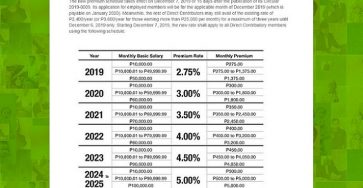
  • Philhealth Contribution Table for Year 2019 to 2025

    Philhealth Contribution Table for Year 2019 to 2025

    I agree of the policy of the State to adopt an integrated and comprehensive approach to health development which shall endeavor to make essential goods, health and other social services available to all the people at affordable cost and to provide free medical care to paupers. [Section 11, Article XVII on Social Justice and Human Rights of the Constitution and typified in Article 1 of Republic Act (R. A.) No. 7875, as amended by R. A. No. 10606, and R. A. No. 11223 otherwise known as the Universal Health Care (UHC) Act of 2019].

    In relation with, Philhealth Circular No. 2019-009 was issued to operationalize the “Individual-based health services” for all Direct Contributors of the National Health Insurance Program (NHIP) by providing set of rules and guidelines on the payment mechanism pursuant to R. A. No. 78775, as amended by the Universal Health Care Act.

    The Circular also stated of the Premium Contribution Table for Direct Contributors and the monthly premium contributions shall be in accordance with the premium rates and monthly income/basic salary floor and ceiling prescribed in the said Act, as follows:

    Please refer https://www.philhealth.gov.ph/circulars/2019/circ2019-0009.pdf of the full text of Philhealth Circular No. 2019-009.

  • The Benefits of Giving & Receiving Company Benefits

    Who else wants to give and receive Company Benefits? Did you know that this action will result advantages or benefits of the work relations and performances of both employers and employees of the business operations in general? But employees should also understand that giving of benefits or any form of other benefits is an act out of generosity of the owners of the Company.

    For the owners & management or authorized person of businesses, it is also important to consider whether these benefits are taxable or not on the part of employers and employees. If your business is operating the Philippines, there’s new regulations the defines Benefits Classified/Considered As “De Minimis” Not Subject To Income Tax as well as Withholding Tax.

    Revenue Memorandum Circular (RMC) No. 50-2018 is a circular that clarifies certain provisions of Revenue Regulations (RR) No. 8-2018 and 11-2018 as amended by RR Nos. 15-2018 and 14-2018, respectively.  The stated RRs were issued to implement the TRAIN law’s income tax provisions including its consequent withholding tax.

    As of January 1, 2018, the following are the “de minimis” benefits:

    a. Monetized unused vacation leave credits of private employees not exceeding ten (10) days during the year;

    b. Monetized value of vacation and sick leave credits paid to government officials and employees;

    c. Medical cash allowance to dependents of employees not exceeding P 1,500.00 per employee per semester or P250.00 per month;

    d. Rice subsidy of P2.000.00 or one (1) sack of 50 kg. rice per month amounting to not more than P2,000.00;

    e. Uniform and clothing allowance not exceeding P6,000.00 per annum;

    f. Actual medical assistance, e.g., medical allowance to cover medical and healthcare needs. annual medical/executive check-up, maternity assistance, and routine consultations, not exceeding P10.000.00 per annum;

    g. Laundry allowance not exceeding P300.00 per rnonth;

    h. Employees achievement awards, e.g., for length of service or safety achievement, which must be in the form of a tangible personal property other tl-ran cash or gift certificate, with an annual monetary value not exceeding P10,000.00 received by the employee under an established written plan which does not discriminate in favor of highly paid employees;

    i. Gifts given during Christmas and major anniversary celebrations not exceeding P5.000.00 per employee per annum

    j. Daily, meal allowance for overtime work and night/grave yard shift not exceeding twenty-five percent (25%) of the basic minimum wage on a per a region basis; and

    k. Benefits received by an employee by virtue of a collective bargaining agreement (CBA) and productivity incentive schemes provided that the total annual monetary value received from both CBA and productivity incentive schemes combined do not exceed ten thousand pesos (P10,000) per employee per taxable year.

    All other benefits given by employers which are not included in the above enumeration shall not be considered as “de minimis” benefits and hence, shall be subject to income tax as well as withholding tax.

    The benefits given in excess of the maximum amount allowed as “de minimis” benefits shall be included as part of “other benefits” which is subject to the P90.000.00 ceiling. Any amount in excess of the P90,000 shall be subject to income tax and consequently, to the withholding tax on compensation.

    At the end of the day, both employers and employees will realize that this will happen if both parties will do their part for the benefits and success of the business operations.
  • Relevance of Keeping of Books of Accounts

    Who are required to Keep Books of Accounts? Do you think Corporations, Companies, Partnerships or Persons need to keep Books of Accounts?

    Generally, Books of Accounts are use in recording all relevant transactions not only for the purpose of internal revenue taxes but for the preparation of Financial Position (Balance Sheet), Results of Operations (Income Statement), Statement of Cash Flows and other relevant reports of the business activities.

    Sec. 71 of RA No. 10963 further amends Section 232 of the NIRC as follows:

    “SEC. 232. Keeping of Books of Accounts.

    “(A) Corporations, Companies, Partnerships or Persons Required to Keep Books of Accounts. – All corporations, companies, partnerships or persons required by law to pay internal revenue taxes shall keep and use relevant and appropriate set of bookkeeping records duly authorized by the Secretary of Finance wherein all transactions and results operations are shown and from which all taxes due the Government may readily and accurately be ascertained and determined any time of the year: Provided, That Corporations, companies, partnerships or persons whose gross annual sales, earnings, receipts or output exceed Three million pesos (P3,000,000), shall have their books of accounts audited and examined yearly by independent Certified Public Accountants and their income tax returns accompanied with a duly accomplished Account Information Form (AIF) which shall contain, among others, information lifted from certified balance sheets, profit and loss statements, schedules listing income-producing properties and the corresponding income therefrom and other relevant statements.

    Republic Act (RA) No. 10963 shall be known as the “Tax Reform for Acceleration and Inclusion (TRAIN)” took effect on January 1, 2018.

    Please refer: https://www.bir.gov.ph/images/bir_files/internal_communications_1/TRAIN%20matters/RA-10963-RRD.pdf of the full text of RA No. 10963.