Month: January 2015

  • ASIA: The World’S Skyscraper Capital

    ASIA: The World’S Skyscraper Capital

    Global property portal looks at region’s sky-high towers.

    Home to the bulk of the tallest towers on the planet, Asia is without a doubt the world’s skyscraper capital. From Dubai to Shanghai, the region dominates the list of the world’s supertall buildings.

    Of the top 10 tallest towers around the world, just two – the recently completed One World Trade Centre in New York City and the Willis Tower in Chicago – are located outside Asia and the Middle East.

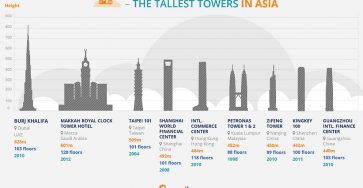
    Stacked one on top of the other, the 10 tallest towers in Asia would measure more than five km into the sky. These top 10 tallest towers are shown on a new infographic, released by global property portal Lamudi.

    With its towering commercial centres and tendency towards high-density living, China leads the world in skyscraper construction. Of the record-breaking 97 buildings measuring 200 meters high or taller that were completed around the world in 2014, 58 of these were located in China. This represents roughly 60 percent of the global total, according to figures recently released by the Council on Tall Buildings and Urban Habitat.

    The city of Dubai currently holds the title for the world’s tallest skyscraper. Reaching 829.8m high, the Burj Khalifa is the tallest artificial structure on earth. For those without a serious fear of heights, the super tower is also home to the world’s highest observation deck, located on the 148th floor.

    The Makkah Royal Clock Tower Hotel in Mecca, Saudi Arabia, is the region’s second tallest tower. Located close to the world’s largest mosque, Masjid al-Haram, the five-star hotel is designed to cater for Muslim pilgrims visiting the holy city. The structure has 76 state-of-the-art elevators offering easy access to the mosque for prayers.

    In third place is Taipei 101 in Taiwan, which stands at 508m and was once the tallest building in the world. The skyscraper’s unique design is based on the number eight, which is considered lucky in Chinese culture. The design was chosen to withstand the earthquakes and typhoons that are common in the country.

    Elsewhere in Asia, the Shanghai World Financial Center, the International Commerce Centre in Hong Kong and the Petronas Towers in Malaysia also make the top 10 list.

    Currently under construction in China is the 632m Shanghai Tower which, once completed later this year, will be the world’s second tallest building. However, at 660m, the Ping An Finance Centre in Shenzhen will overtake the Shanghai Tower in 2016.

    Set to reach 1km into the sky, the Kingdom Tower in Saudi Arabia will take the title of the world’s tallest building once it is completed in 2019.

    ABOUT LAMUDI

    Launched in 2013, Lamudi is a global property portal focusing exclusively on emerging markets. The fast-growing platform is currently available in 28 countries in Asia, the Middle East, Africa and Latin America, with more than 800,000 real estate listings across its global network. The leading real estate marketplace offers sellers, buyers, landlords and renters a secure and easy-to-use platform to find or list properties online. For more information, please visit http://www.lamudi.com.ph

    Visit  Lamudi Philippines on  Facebook, Twitter, Google+ and LinkedIn.

    REFERENCE & MEDIA CONTACT

    Rodel Ambas

    Head of Content and PR, Lamudi Philippines

    Email: rodel.ambas@lamudi.com.ph Phone: +63 917 3015127

  • GetMed: Revolutionizing healthcare in the Philippines

    GetMed: Revolutionizing healthcare in the Philippines

    We have all experienced the difficulties of finding a doctor and quickly get an appointment. More importantly, on emergency situations, we might not even have an idea where the nearest hospital is or which doctor to call.

    For Arthur John Abarquez, one of the founders of UNA I.T. SOLUTIONS, it was on a Maundy Thursday a few years ago when his wife suffered a serious fall, which resulted to shattered bones in her left forearm and hand that compelled him to recognize this need. “We rushed my wife to the hospital but the ER Doctors couldn’t do anything to relieve her pain. They needed a specialist who, at that time, since it was a holiday, was not available. It took them several hours to locate a doctor who had to travel from Calatagan, Batangas to Manila. It was grueling hours of waiting for my wife and myself. I wanted so much to help her but I was helpless, we were at the mercy of the capabilities and the reaction time of the hospital where we brought her,” he shared.

    “Had a medical directory, at the very least, been available then, it would have helped us locate the nearest available doctor, not necessarily from the hospital we brought her to but still within immediate reach,” Arthur added.

    UNA I.T. SOLUTIONS, the company behind the Health Lifestyle app called GetMed, envisions the product to revolutionize healthcare in the Philippines. The company was built in collaboration with some of the country’s profile experts in pharma, information technology, and consumer marketing – all coming together for one direction – to develop a product that would give everybody an upperhand in managing their healthcare, emergency or otherwise.

    GetMed simplifies patient experience in just one touch of a button. Just as how we use online tools to book a restaurant or request for a cab service, patients will certainly demand the same experience in self-booking a doctor’s appointment.

    “You would not even want to entertain the idea of waiting,” says Paolo Castaño, a reputable pharma and marketing expert, “so GetMed capitalizes on convenience. With the app, you can conveniently book appointments with MDs, find out nearest hospitals or clinics. The app can immediately give you a directory of doctors grouped geographically and according to specialization.” It is also linked to Waze so you get to manage traffic as you proceed with your respective appointments.

    Unlike the many medical apps which are limited to information base, GetMed is highly interactive. “The app is not just an information base, but engages the doctors, patients, and helps build a better lifestyle on day-to-day basis,” shares Chris Hatton, an I.T. expert who had professional stints with a leading global software company in Europe & the Middle East and specialized in Government contracts.

    A free download, GetMed Version 1 is available in Android and IOS version. Initially, Version 1 has over 17,000 registered doctors on the database, covering the majority of the country. It also has over 3,000 Hospitals, Clinics & Barangay Health Centres located in Luzon, Visayas & Mindanao. All listings for both doctors and hospitals are 95% accurate.

    “A lot of things are coming for the app,” says Chris, “but we do not want to rush things. Importance of the app right now, with Version 1, is the simplicity and usefulness. We just want to make sure we are doing it the correct manner.”

    GetMed is aimed at making the Philippines a major player in the app-business, a product that is made in the Philippines that will make us proud. Its mission is to bring healthcare at the touch of a button, manage your healthcare more efficiently, conveniently and more precise.

    From L-R- Arthur John Abarquez, Paolo Castaño and Chris Hatton

    “We believe in the project. And Philippines is the right place to launch this kind of product and that’s important. We have such great faith in the Philippines. Great technology skills. We’re very Filipino. We have Filipino staff. We use Filipino developers. We are proud that this is a Filipino-made product. It’s the first time that we are consolidating the data of doctors and patients into one big picture. We’re bringing quality life.”

    REFERENCE:

    Jerome G. Samson
    Event and Activation
    09167861568
    jerome.g.samson@gmail.com

  • Infographic: What will your house look like in 10 years?

    Infographic: What will your house look like in 10 years?

    Smart home technology gaining traction in emerging markets.

    From the moment you wake up in the morning, the house reacts to your needs. The automated lights turn on slowly to wake you up at a scheduled time. From the comfort of your bed, you switch on your coffee machine so your morning cup is fresh and hot by the time you arrive downstairs for breakfast.

    You enter the bathroom and stand in front of your intelligent mirror. The mirror’s reflective surface springs to life with all the information you need to kick-start your day, including the weather and the morning’s top news. The device also plays your favourite music so you are always guaranteed to start the day in a good mood.

    After getting ready, you go to the kitchen for breakfast where your smart refrigerator alerts you that you are nearly out of milk. With the tap of a finger on the fridge’s touch screen, you can restock your fridge and order all your groceries for the week through an online store.

    The infiltration of technology to assist with these small daily tasks may just be the beginning. The fully-connected home is designed to boost energy efficiency, protect against intruders and even monitor your family’s health. With the rapid growth in the home automation industry, so-called smart home systems have already hit the mainstream – although the high cost of such devices keeps them out of reach for many. But there are signs that this is about to change.

    This year, revenue from the smart home market is expected to exceed $US48 billion, according to recent Strategy Analytics forecasts. By 2019, the sector’s market revenue will increase to $115 billion. By the end of this decade, nearly 12 percent of global households will have at least one type of smart system installed. In fact, Tony Fadell, the CEO of Nest – the connected homes product company that was bought by Google earlier this year – has predicted that within a decade, every electrical device in your home will be connected to the internet.

    While the smart home market is quickly gaining traction in developed countries, there are now signs that the trend is spreading to the emerging markets. Consumers in the Asia Pacific region has been particularly keen to embrace the new connected technologies, as tech companies begin to acknowledge the opportunities in this sector.

    Connected home firm Icontrol Networks expanded to Asia in October, with the company partnering with a Japanese cable provider to offer a smart home system that consumers can install themselves. This month, Chinese electronics firm Xiaomi invested 1.26 billion yuan (about $200 million) in home appliance company Midea, as it looks to expand into the smart homes market.

    Lamudi’s Global Co-Founder and Managing Director, Kian Moini, said: “The smart home concept is all about making living much more comfortable, as well as more efficient, which means that the concept has universal appeal. As prices come down in the coming years and people worldwide begin to focus more on issues such as energy saving, we expect to see this trend sweep the emerging markets as well.”

    REFERENCE & MEDIA CONTACT

    Rodel Ambas
    Head of Content and PR, Lamudi Philippines
    Email: rodel.ambas@lamudi.com.ph
    Phone: +63 917 3015127